
The deck questions our Seattle clients ask most during site visits (and our honest answers)
We do a lot of site visits. Some weeks, that’s most of what we do — walking somebody’s backyard in Magnolia, climbing onto a flat roof off a Fremont kitchen, standing in the rain on a Bellevue hillside trying to picture how a deck would actually sit on the slope.
After enough of these, you notice the same questions come up. Not because Seattle homeowners are unprepared — most have done their homework. It’s that a few questions are genuinely hard to answer from a website, and they tend to get asked once we’re actually standing on the property.
Here are the ones we hear most, and what we actually tell people.
“How much is this going to cost?”
Almost always the first question, sometimes before we’ve even gotten out of the truck.
The honest answer is that we can usually give a rough range on site, and a real number after we’ve measured, pulled the parcel info, and figured out what the permit path looks like. For a straightforward ground-level deck in a Seattle neighborhood like Greenwood or Ravenna, we’re often in the $35–$60 per square foot range with pressure-treated framing and cedar decking. Composite pushes it higher. Ipe pushes it higher still. A second-story deck with new footings, posts, and stairs is a different conversation entirely, and so is anything on a slope.
What changes the number more than material choice, in our experience: footings, access, demo, and railings. We’ve quoted two decks the same week that were the same size on paper and came in $18,000 apart because one needed a crane to get materials over the house and the other didn’t.
If you want a sense of what your project might look like, the main deck builder page has examples of recent builds across the city.
“Do I need a permit?”
Most of the time, yes. Seattle SDCI requires a construction permit for decks more than 30 inches above grade, and there are also rules about lot coverage, setbacks, and what you can build near an environmentally critical area. You can read the city’s own summary on the SDCI decks page, which we send to almost every client.
A few specific situations that catch homeowners off guard:
- A deck that’s 28 inches above grade at the house but 50 inches above grade at the far end of a sloped lot still counts as the higher number for permit purposes.
- If your lot is near a steep slope, wetland, or shoreline, you may need a pre-application site visit before you can even apply. This is the Environmentally Critical Areas piece, and it adds time.
- Replacing an existing deck on the same footprint sometimes qualifies for a simpler subject-to-field-inspection permit. Sometimes. We don’t promise this until we’ve checked the parcel.
We pull permits for clients. It’s part of what we do. But you should know going in that permit timelines in Seattle right now run anywhere from a few weeks for STFI to a few months for full plan review.
“How long will the build take?”
The build itself, for a typical residential deck, is usually two to four weeks of actual on-site work. The full project from signed contract to final inspection is longer because of permit review and material lead times, especially for anything with custom railings or imported hardwoods.
The thing we try to set expectations on early: weather is real. Seattle has working windows even in winter, and we build year-round, but pours and certain framing steps need a few dry days lined up. A January start doesn’t mean a January finish.
“What material should I use?”
This is the question we have the longest conversation about, and the one where we try hardest not to push a single answer.
Cedar is local, looks great when it’s new, and smells incredible when it’s fresh. It also turns silver-gray within a couple years if you don’t oil it, and it’s softer than the alternatives, so it shows wear faster.
Composite (Trex, TimberTech, Deckorators) doesn’t fade much, doesn’t splinter, and costs more upfront. The good ones are genuinely good now. The cheap ones still get hot in direct sun, which matters on a south-facing Seattle deck in August more than people expect.
Ipe and other tropical hardwoods are dense, dark, and last decades, but they’re heavy on framing, hard on tools, and the supply chain has gotten uncertain. We’ve had clients fall in love with ipe samples and then get surprised by the price six weeks later.
The right material depends on your house, your view, your maintenance tolerance, and what you actually do on a deck. There’s no universal answer here. We wrote more about this in our post on the most popular deck types in Seattle.
“Can you cover it?”
Yes, and this is a question that comes up about a third of the way through most site visits, usually after someone looks at the sky.
The options we talk through most:
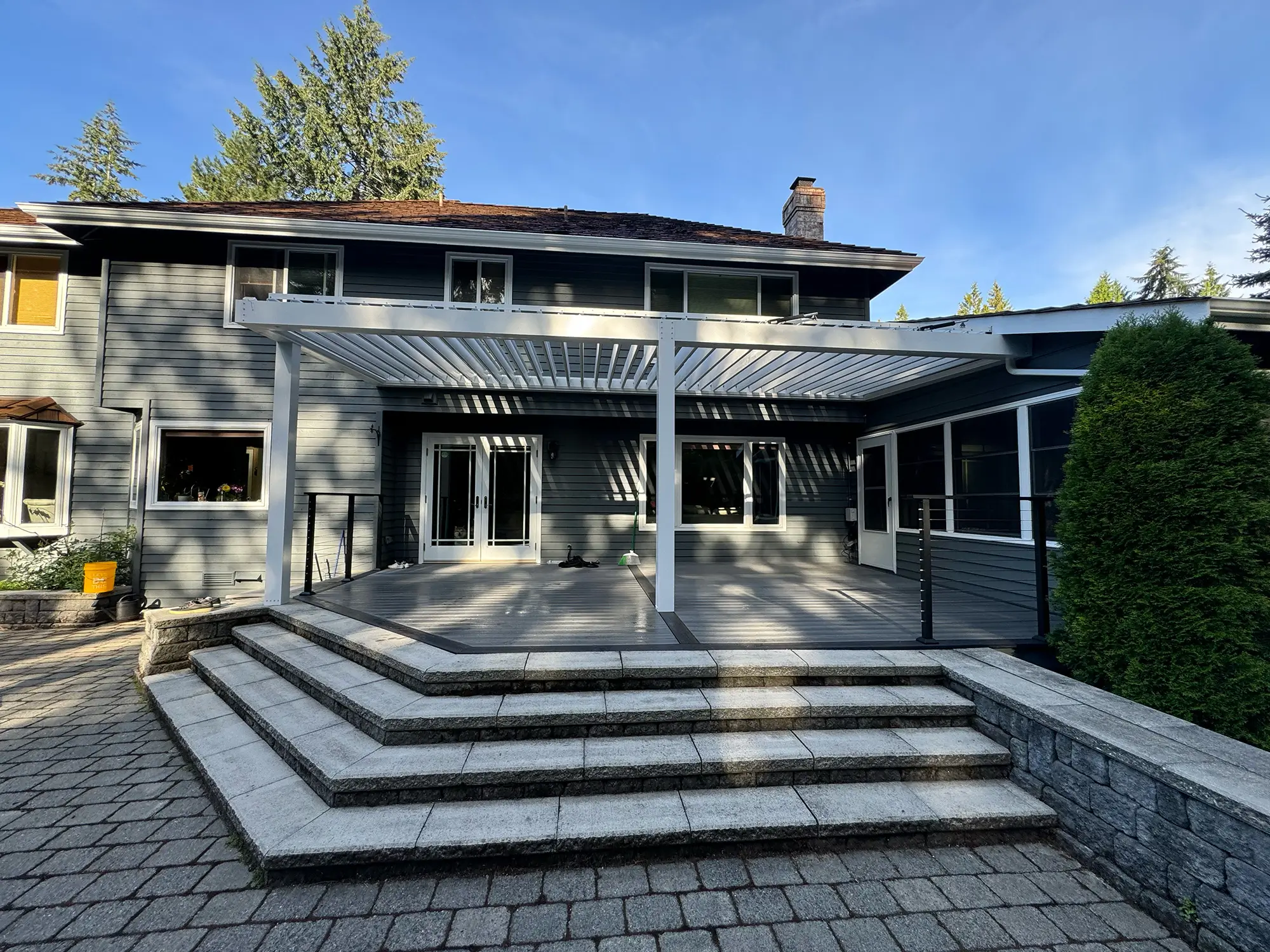
A louvered roof gives you the most control. You can close it when it’s raining, open it when it’s not, and run it from a phone. It’s the most expensive of the covered options and the one most people end up wanting once they see it work. We covered the reasoning in our post on motorized louvered roofs.
An acrylic patio cover is fixed, lets light through, and is the right answer when you want a permanently dry deck without the mechanism cost.
A pergola without a roof gives you shade structure and the option to add fabric or vines later. It’s the lightest commitment.
Whatever you pick affects footings and framing, so it’s a decision we’d rather make at the design stage than retrofit later.
“Will it ruin my view?”
We hear this most on Eastside lake-view properties and west-facing Seattle homes that look toward the Sound. It’s a real concern. A railing in the wrong place changes the view from a couch you’ll be sitting on for the next twenty years.
The honest answer is that railing style matters more than people think. Cable rail, glass panels, and slim metal balusters preserve sightlines very differently. We usually mock up the railing height with a string line during the site visit so you can stand where you’ll actually stand and see what you’ll actually see.
Code in Seattle requires guardrails on any walking surface more than 30 inches above grade, and they have to be 36 or 42 inches tall depending on the situation. There’s no way around that. But within those constraints, there’s a lot of room to design something that doesn’t fight the view.
“Will my deck handle the rain?”
We get this one a lot from clients who’ve moved here from drier places.
Decks built right in Seattle handle the rain fine. Decks built wrong rot from underneath. It usually starts at the ledger board where the deck attaches to the house, and usually because someone skipped flashing or used the wrong fasteners. That’s where most of the deck failures we get called to repair start — not on the surface boards, but at the connection points where water finds its way in.
What we do differently: stainless or coated structural fasteners, properly lapped flashing at every house connection, joist tape on top of every joist, and ventilation underneath. None of this is exotic. It’s just the part of the build no one sees, which is exactly why corners get cut on it.
“What about my dog/kids/hot tub?”
Worth bringing up early, because all three change the design.
Dogs: gap spacing between boards matters for paws. Cable rail is not always a good idea if you have a climber.
Kids: balusters need to be close enough that a head can’t fit through. Code handles this, but it limits some railing choices.
Hot tubs: this is the big one. A 500-gallon tub plus water plus people is a real load. We need to know about it before we design the framing, not after.
“Can we start in two weeks?”
Sometimes, sometimes not. It depends on the permit path, our current schedule, and what materials we need to order. We don’t book projects we can’t deliver on, which means our honest answer in spring is usually “we can start the design now, and break ground in roughly six to ten weeks.” In fall and winter, lead times get shorter.
If you want to walk through your project, we do site visits across Seattle and the Eastside, and there’s no pressure to commit on the spot. You can reach us through the contact page or by calling the number at the top of every page.
We’d rather talk through these questions before you sign anything than after. It saves both of us trouble down the line.