 Privacy
 Screens
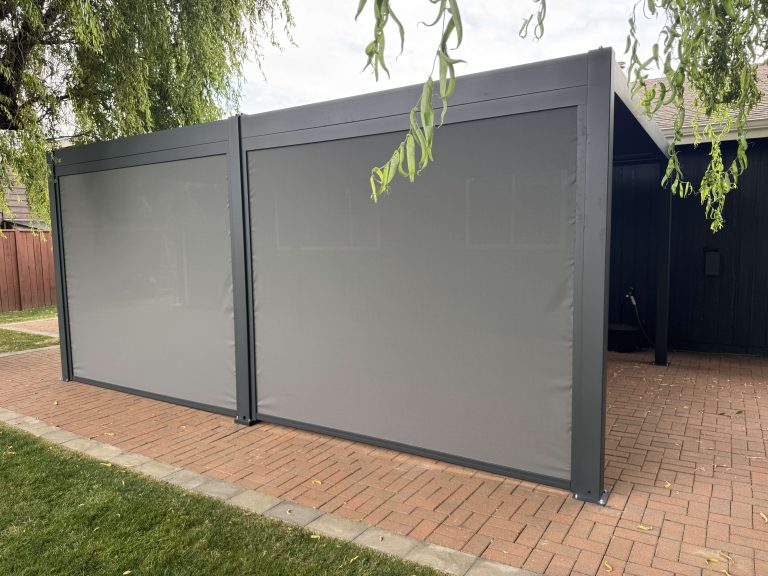
- Keeps the neighbors from seeing in
- Good for decks right next door
- Go denser or blackout for night privacy

Star Construction WA installs custom exterior solar shades, motorized patio screens and retractable patio screens for homes in Seattle and across the Eastside. Every screen is made to order by Rainier for your exact opening and installed by our own crew. We are a Washington State licensed contractor (license #STARCCW791L5), owned and operated by Ruslan Bencheci.
One button drops the screen: shade when the afternoon sun hits, bug protection at dusk, and an open patio the rest of the time.
Call (206) 600-2225 · Monday to Saturday, 7am to 7pm
The same motorized screen does a different job depending on the time of day and the fabric you choose. Here are three ways to put them to work around a Seattle home.
Privacy
 Sun & Heat
 Outdoor Living
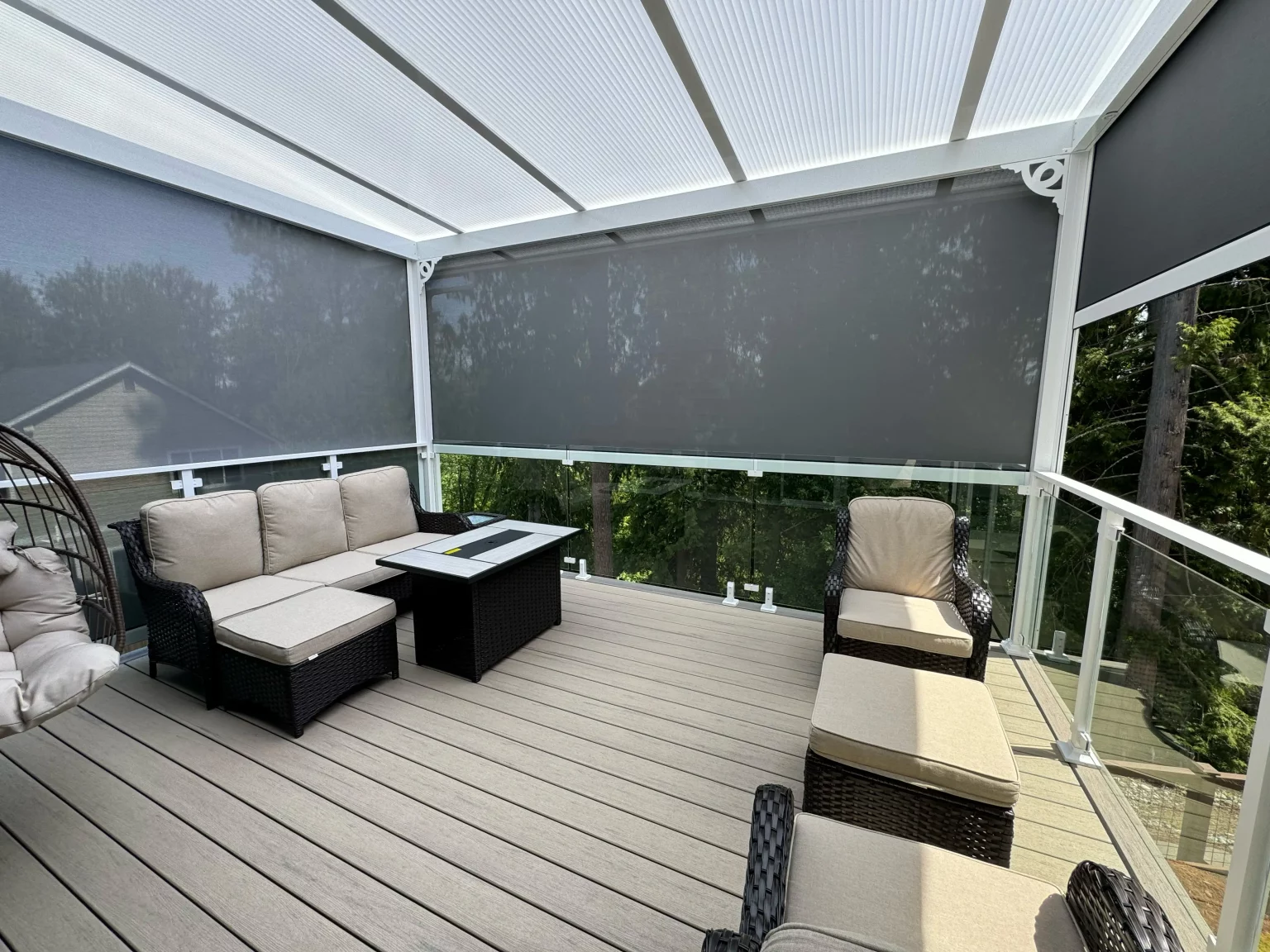
Both photos show the same covered balcony with the solar shade lowered. From the street, the screen looks like a solid dark panel, and you can’t see the furniture or anyone sitting there. From the sofa, the street, the houses across the way and the sky are all still in view.
Solar mesh works this way because it’s brighter outside than under the cover during the day. The fabric blocks the view in and lets you see out. A more open weave keeps more of the view, and a denser one adds privacy and heat control.
After dark, with your lights on, the effect reverses. If you want privacy in the evening as well, a privacy weave or blackout fabric is the better fit.


Exterior solar shades are fabric screens that roll down outside a window, patio or porch opening and stop the sun’s heat before it reaches the glass. Ours are motorized, run in side tracks and retract into an aluminum housing when you don’t need them.
Our motorized outdoor screens are manufactured by Rainier, a Pacific Northwest company that has been building custom retractable shading systems for decades. These are motorized outdoor shades with side tracks: the fabric edges ride in a track on each side, so the screen stays taut in wind instead of flapping like a curtain. When you retract it, the fabric rolls up into a powder coated aluminum housing and is out of sight.
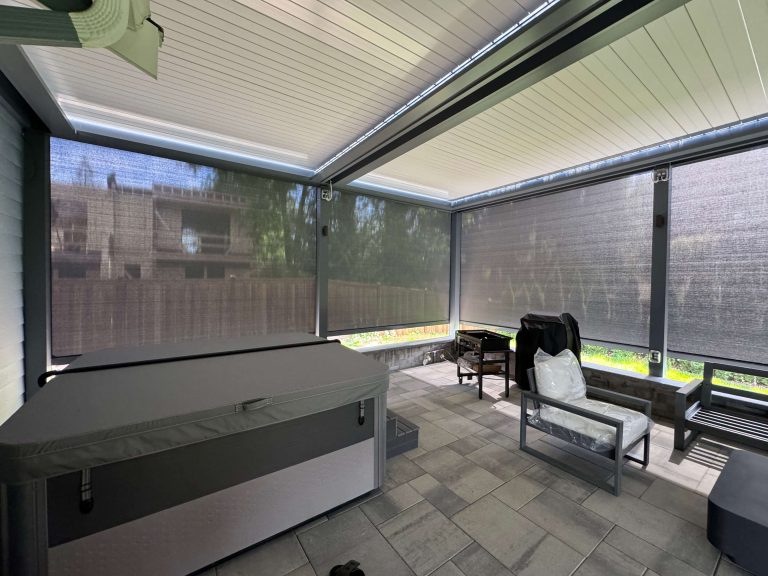
The fabric does real work. It filters most of the sun’s UV before it reaches your furniture and flooring, cuts glare on TVs and laptops, and lowers the heat load on the rooms behind it. That matters more every summer here. Seattle hit 108°F during the June 2021 heat wave, and plenty of homes in the city still have no air conditioning.
You keep your view. From inside, exterior roller shades read like a light tint over the opening, and you can still see the yard and the street through the fabric.
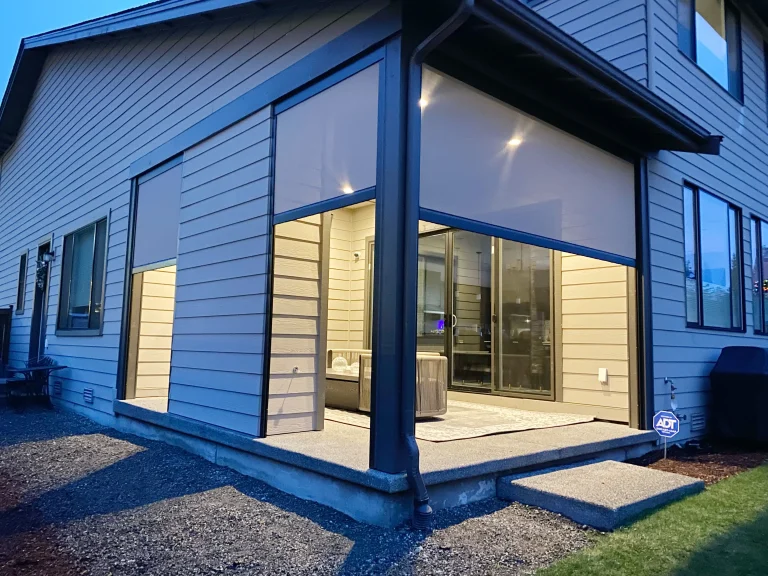
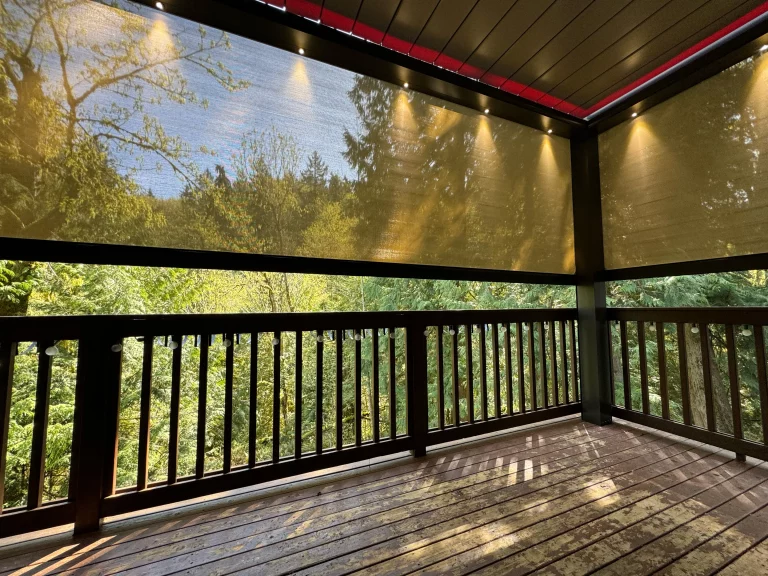
One button sets the patio up for the time of day.
We install Rainier motorized shading systems, from a Pacific Northwest company that builds for Pacific Northwest weather. We measure every opening ourselves, Rainier makes each screen to those measurements, and our own crew installs it.
We don’t stock standard sizes. Each set of custom exterior shades (some people call them custom outdoor roller blinds) is measured to your opening, whether that’s a 6-foot porch bay or a 20-foot covered patio span. The right fabric depends on what you’re trying to fix.
A more open weave blocks most of the sun and glare while you still see out. It’s the usual pick for exterior solar roller shades on a view deck or a west-facing patio, where you want relief from the 5 p.m. sun without losing the yard.
A denser weave turns the shade into an outdoor privacy screen, which helps when the neighbor’s deck looks straight onto yours, and a motorized privacy screen rolls back up when you want the view. One caution: outdoor privacy shades in solar mesh work in daylight, but after dark, with lights on under your cover, people can see in. Go denser or blackout if evening privacy matters.
Full blackout keeps a west-facing bedroom or media room dark in the evening. Mounted outside the window, it also stops heat before it reaches the glass, which interior blinds can’t do.
Several of our exterior fabrics carry 10-year limited warranties.
Frames and housings for our custom motorized patio screens come in 16 standard colors. Each screen is made to order with a factory powder coat finish that looks like an appliance and needs almost no maintenance. Custom colors are available at an additional cost.

The newer square housing suits modern and contemporary homes. The traditional, more rounded housing is still the most popular choice with homeowners.

On a covered patio, a motorized retractable patio screen mounts to the beam or header, the fabric drops in side tracks fixed to each post, and the opening closes edge to edge. Outdoor roller shades for patio covers deal with the sun a roof can’t stop: the low-angle light that comes in under the edge late in the afternoon. If the sun only hits from the west, a single motorized screen for patio shade on that side is often enough.
Screens and pergolas are a natural pair, and we build both. A louvered pergola with retractable screens gives you a roof that opens and walls that disappear. The louvers handle rain and overhead sun; the screens handle wind, bugs and low-angle glare. We can add pergola screens and shades to a pergola we build for you, or retrofit them onto an existing structure if the posts can carry the tracks. If you’re comparing a pergola with motorized screens against a fixed-roof option, our acrylic patio covers page covers the other route.
Shopping for a pull down patio screen or a patio shade curtain? Electric shades for patio openings do the pulling for you, and because the fabric edges stay in the tracks, they don’t billow in a breeze.
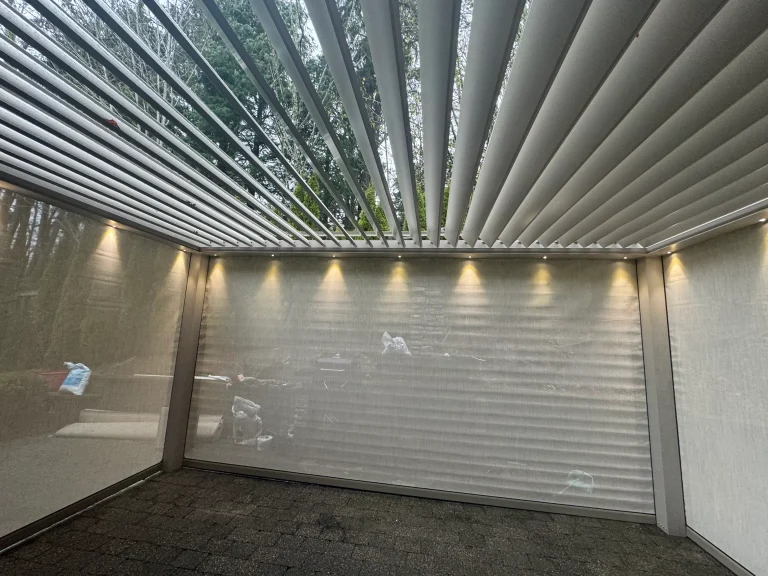
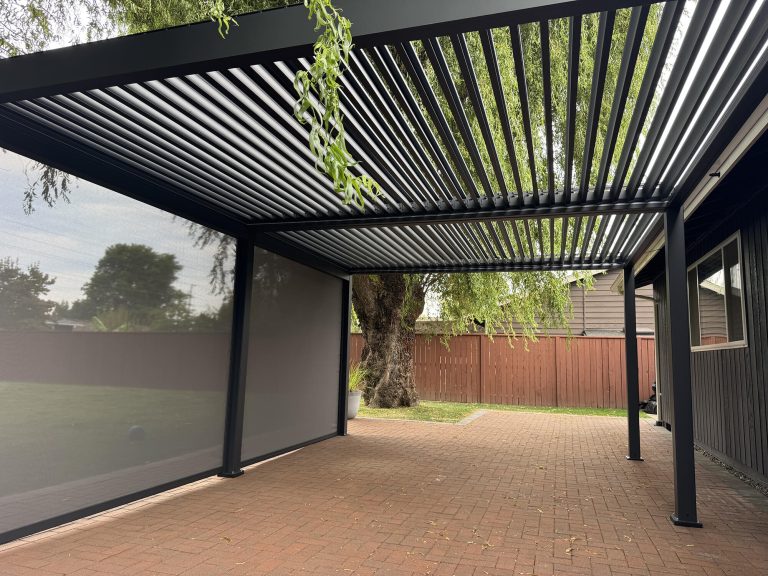
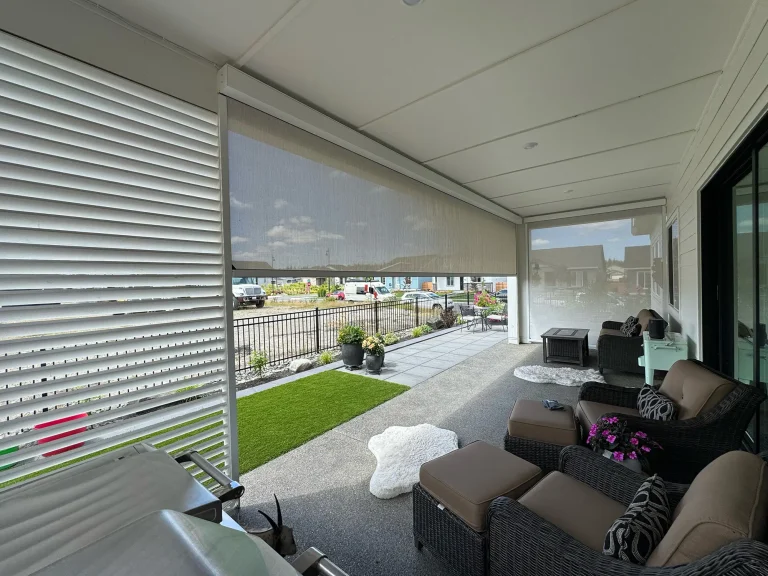
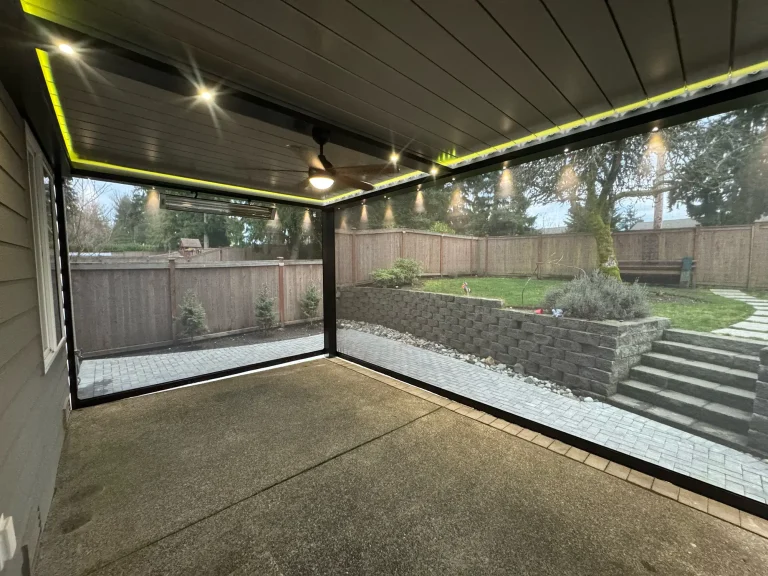
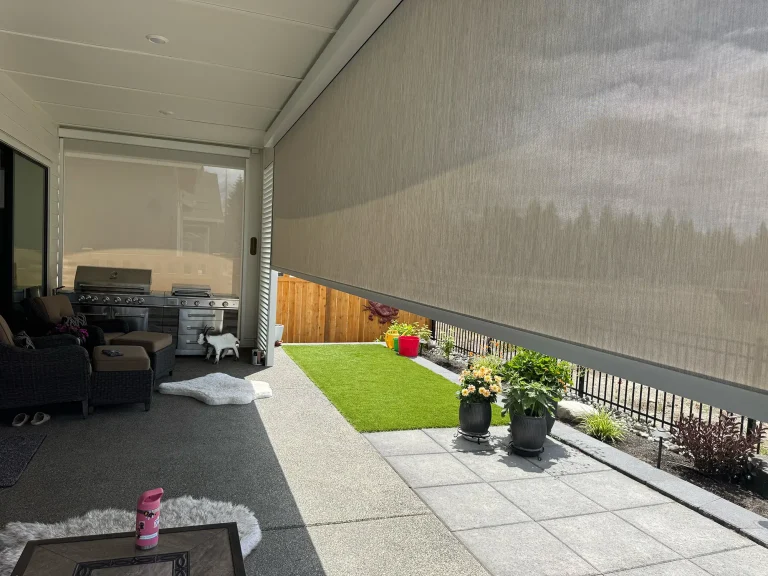
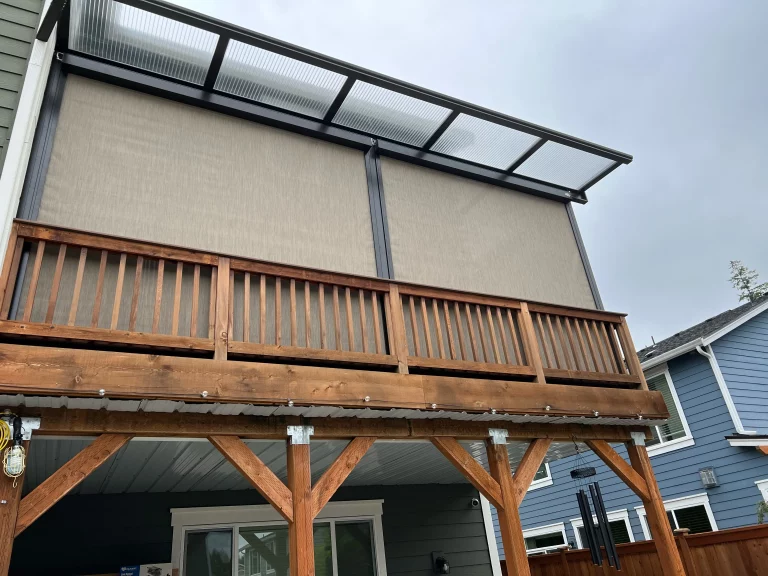
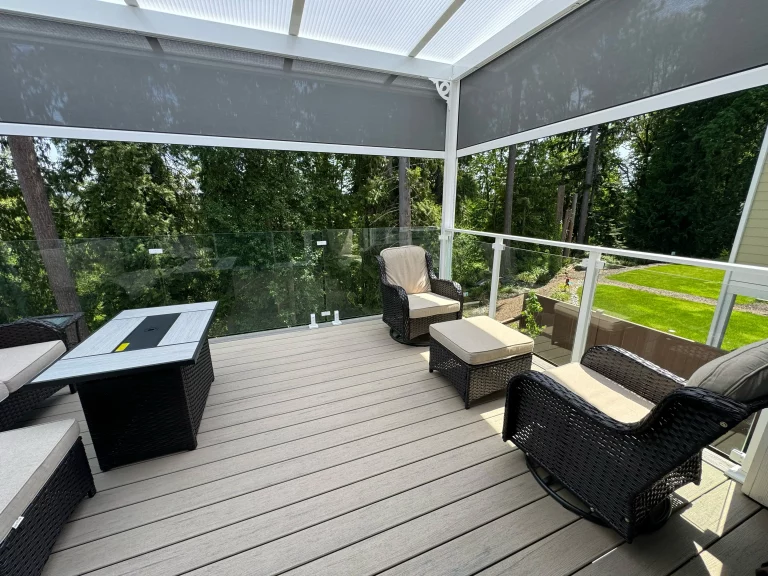
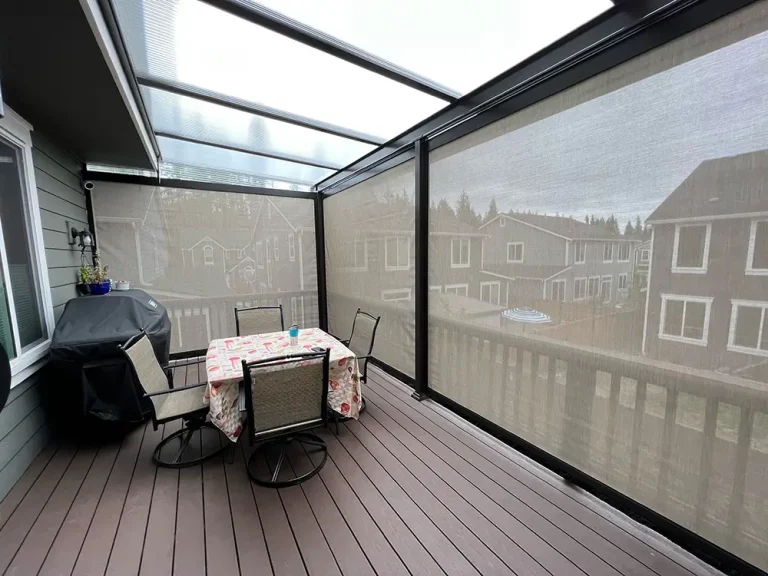
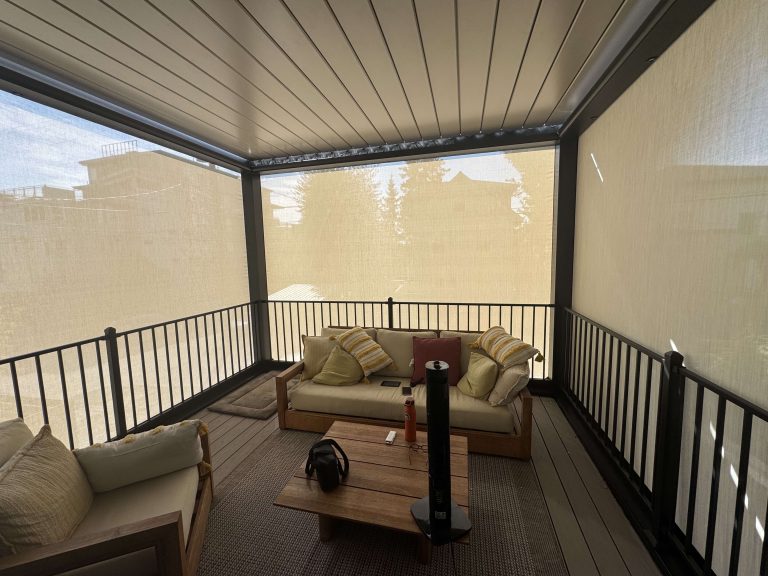
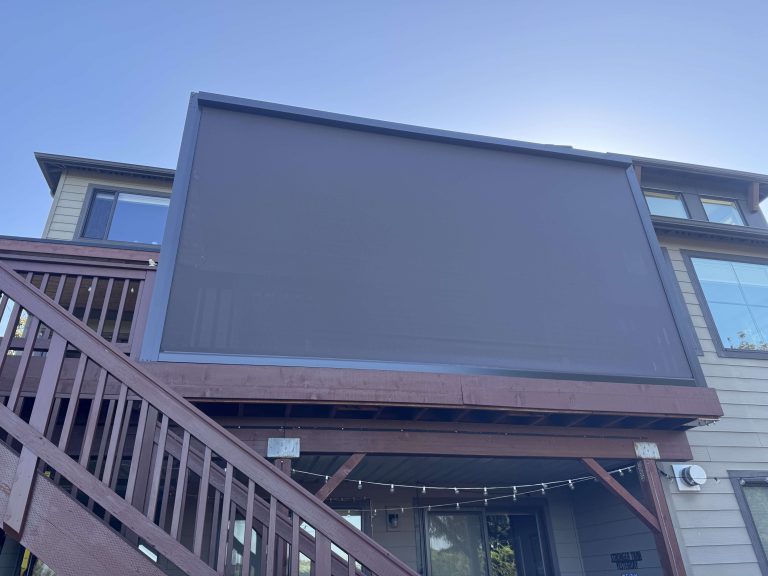
Decks and porches take the same treatment. Retractable deck screens mount to a covered deck’s posts or framing and turn it into a three-season room without permanent walls. Electric porch screens do the same for a front or back porch, and they’re one of the simplest upgrades we install: most porch openings need one screen and one switch.
Upper decks and covered balconies get the same screens. On a second-story deck, outdoor balcony shades cut the wind coming across the railing and block the sightline from the house next door. Choose a privacy weave and the shade works as a retractable deck privacy screen you can raise again when you have the place to yourself.
Screen porch enclosures built from fixed panels keep bugs out, but the porch stays closed in. Motorized porch shades give you the same protection and roll up out of sight. For covered porch enclosures with glass walls, see our sunrooms and balcony glazing page. If your deck isn’t covered yet, we’re also deck builders, so we can handle the structure and the screens as one project. For shade over an open deck with no roof at all, look at our motorized retractable awnings.
The same system works on windows. Motorized exterior window shades mount on the outside wall above the window and drop in side tracks over the glass. Because the fabric sits outside, it blocks the sun before the heat gets through the window. Interior blinds catch that heat after it’s already in the room.
Exterior sun shades for windows make the biggest difference on west- and south-facing walls with a lot of glass, and in upstairs bedrooms that stay hot long after sunset. You can run outdoor window shades on their own or pair them with patio screens on the same wall so the whole side of the house matches.
Some people call these exterior blinds for windows or external blinds for windows. They’re the same exterior home shades we put on patios, with the same roller, housing and side tracks, sized to the window.
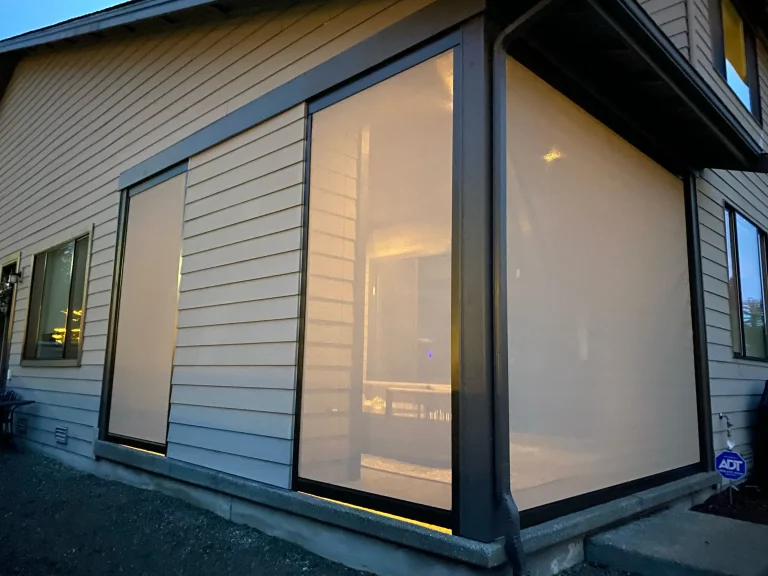
Rainier has been building custom retractable shading systems in the Pacific Northwest for decades, and their screens are made for the conditions we deal with here: long wet seasons, gusty afternoons and a few weeks of hard summer sun. Rainier makes every screen to order from the measurements we take, and our own crew installs it.
People search for both, and they’re different products. Motorized shades (this page) are exterior fabric screens that stop heat before it hits the glass, which is why they outperform anything mounted inside. Motorized blinds are interior window coverings, slatted or cellular, controlled the same way but working from the inside.
| Option | Where It Mounts | What It Handles Best | Learn More |
|---|---|---|---|
| Exterior solar shades and motorized patio screens This Page |
Outside: patio and porch openings, pergolas, decks, windows | Heat, glare, UV, bugs, daytime privacy and wind on a covered space | You’re here |
| Interior motorized blinds | Inside the window frame | Light and privacy control inside a room | Interior window coverings |
| Motorized retractable awnings | House wall above an open deck or patio | Overhead shade where there’s no roof | Retractable awnings |
| Louvered pergola | Freestanding or attached to the house | Rain and overhead sun, with louvers you can open | Louvered pergolas |
| Acrylic patio cover | Fixed roof over a patio or deck | Year-round rain cover that still lets light through | Acrylic patio covers |
Swipe the table sideways to see every column.
Not sure which you need? The short answer: for a heat problem, go exterior. For light and privacy control inside a room, interior blinds usually do it. We install both.
Manufacturers and homeowners use different names for the same product, which makes shopping confusing. Here’s how the common terms line up with what we install.
One product family: an exterior fabric made to block sun and heat while you can still see through it. Ours are motorized and run in side tracks.
These names describe how the fabric moves. It winds onto a roller tube inside the housing, so when the shade is up, all you see is the housing.
Strictly speaking, blinds have slats. Most outdoor blinds for patio use are fabric roller shades, and that’s what we install. Slatted motorized blinds belong inside the window.
Any of the above with a motor. Every screen we install is motorized, so motorized outdoor blinds and outdoor automatic blinds describe it too. We set up the switch or remote for your openings.
Manual versions you lower by hand, or fabric panels hung from a rod. They cost less, but loose fabric flaps in the wind. A motorized screen in side tracks stays flat.
A screen product sized for one doorway. If you’re looking at a retractable screen door because of a wide slider or an open patio wall, one motorized screen can cover the whole opening.
Usually fixed screen panels framed into the opening. A motorized outdoor screen for patio or porch openings keeps bugs out the same way and rolls up when you want the space open again.
The same fabric, housing and tracks, mounted over a window instead of a patio opening. See exterior window shades above.
These are the conditions we plan around when we spec outdoor shades for patio, deck and window openings in the Seattle area.
A patio cover blocks sun from above, but in summer the worst sun comes in low from the west after 4 p.m. On a west-facing deck in West Seattle, Magnolia or along the Kirkland waterfront, it comes straight in under the roof edge, and a vertical screen in side tracks blocks it.
The fabric is made for exterior use, and the housing protects the roll when it’s retracted. Mesh lets some wind-driven rain through, so a screen won’t make a patio dry, but it does cut the wind and a lot of the spray.
The side tracks hold the fabric edges, so the screen stays taut in gusts. In a serious windstorm, retract it. That’s standard practice for any retractable system, ours included.
Summer evenings near Lake Washington, Green Lake and the Sammamish River bring out the mosquitoes. With the fabric edges held in the tracks, a lowered screen keeps most of them off a covered patio or porch.
If you’ve been searching for screen patio companies near you, here’s what makes us different from the national outfits. We are a Seattle-area motorized shading company in the literal sense: our office is at 2220 164th Pl SE in Bothell, and the person who measures your opening and the crew who installs your screens both work for us.
Owner and CEO Ruslan Bencheci runs the company under Washington State contractor license #STARCCW791L5. We’ve installed screens through enough Puget Sound winters to know what holds up here and what doesn’t.
One promise we take seriously: we deliver every project as quoted. You won’t get surprise change orders, and the crew that starts your job is the crew that finishes it.
2220 164th Pl SE, Bothell, WA 98012
Get Directions
Monday to Saturday, 7am to 7pm
Sunday closed
Here’s how a screen project runs with us, from the first visit to the day you press the button yourself.
We come out, measure each opening and check the posts or framing that will carry the side tracks and housing. If the structure can’t take it, we’ll tell you what it would need.
You choose a fabric for view, privacy or blackout, and a frame color from the 16 standard colors. Custom colors are available for an upcharge.
You get a real number for your exact openings instead of a range, along with the current lead time for your fabric.
We order your screens from Rainier using our measurements, and each one is manufactured for your exact openings. Lead time depends on the production schedule and your fabric selection.
Most installs are done in a day once your screens arrive. Our own crew does the work from start to finish.
Before we leave, we run every screen with you and go over fabric care and what to do when a big wind is in the forecast.
We install solar shades, motorized patio screens and exterior shades throughout the Seattle metro area. Click a city below to see local projects, or call (206) 600-2225 for areas not listed.
Inside Seattle city limits we cover every neighborhood, including Ballard, Fremont, Wallingford, Queen Anne, Magnolia, Capitol Hill, Madison Park, Laurelhurst, West Seattle and the Rainier Valley.
Patio motorized screens, pergola screens, deck shades and porch shades we’ve installed around the Seattle area.


Rated Excellent on Google by homeowners and businesses across the Puget Sound region.
Price depends on the width of the opening, the fabric you choose and how the motor gets wired. A single porch screen costs much less than a 20-foot patio span with blackout fabric. Quotes are free and we measure on site, so call (206) 600-2225 and we’ll give you a real number instead of a range.
If you’re in Seattle, on the Eastside, or anywhere from Everett down to Tacoma and Bonney Lake, yes. Our crew is based in Bothell and covers the full metro area listed on this page, including every Seattle neighborhood.
Usually. The posts or framing need to carry the side tracks and housing, which most well-built structures can. We confirm that during the free on-site measure. If the structure can’t take it, we’ll tell you what it would need.
That’s what they’re built for. The fabric is designed for exterior use, the side tracks keep it tensioned in wind, and the aluminum housing protects the roll when it’s retracted. In a serious windstorm, retract the screen; that’s standard practice for any retractable system.
Solar shades mount outside and stop heat before it reaches the glass. Motorized blinds mount inside and control light and privacy. Exterior wins on heat every time. We install both, so you don’t have to guess; we’ll tell you which one fits the problem you’re solving.
Most installs are done in a day once your screens arrive. Because every screen is made to order by the manufacturer, the lead time before installation depends on the production schedule and your fabric selection. We’ll give you the current timeline with your quote.
Not with standard solar mesh. In daylight it’s brighter outside than under your patio cover, so people can’t see in. After dark, with your lights on, that reverses and the mesh becomes see-through from outside. If you want privacy in the evening, choose a denser privacy weave or blackout fabric.
Yes. Motorized exterior window shades use the same housing, side tracks and fabrics as our patio screens, mounted on the outside wall above the window. They help most on west- and south-facing glass and in upstairs rooms that overheat in summer.
Usually, yes. On a sloped patio cover we mount the housing level on a beam or header and run the screen straight down in side tracks. A roller screen can’t fill a triangular gable opening, so during the measure we’ll show you exactly where the screen line will sit.
They keep most of them out. When the screen is down, the fabric edges sit inside the side tracks, so there’s no loose gap at the sides for mosquitoes and moths to get through.
Every screen we install is motorized, so you raise and lower it with a switch or a remote. Most porch openings need one screen and one switch. We’ll go over the control options for your setup, and where the motor wiring will run, during the free on-site measure.
For wide openings, yes. A retractable screen door is sized for a single doorway. If you have a wide slider or an open patio wall, one motorized screen can cover the whole opening and roll up into its housing when you don’t need it.
Ready to use your patio again? Call (206) 600-2225, email [email protected], or request a free quote online and we’ll set up your on-site measure.
Monday to Saturday, 7am to 7pm · Serving King, Snohomish And Pierce Counties


