
Emergency board-up & site security
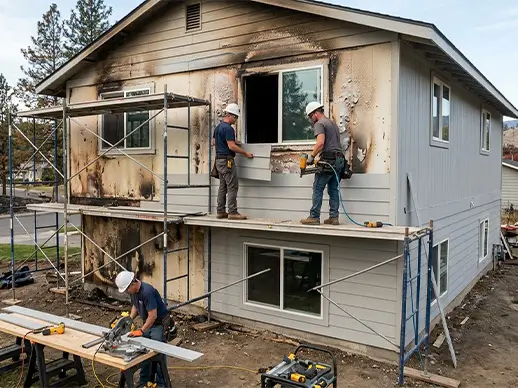
We board window and door openings, install temporary fencing around unstable areas, tarp what is left of the roof, and post signage.
A Washington State licensed general contractor rebuilding homes damaged by the Old Trails, Autumn Lane, and Fairview fires. Debris removal, smoke remediation, and full reconstruction — one contractor, one contract, one schedule.
Free damage assessment — call direct (206) 600-2225WA License #STARCCW791L5 · Bonded & insured · Owner-operated by Ruslan Bencheci · Financing available · Mon–Sat, 7am–7pm
The Old Trails, Autumn Lane, and Fairview fires burned through Spokane County starting August 1. Around 700 structures were lost and roughly 65,000 people were told to evacuate. Governor Ferguson declared a state of emergency and FEMA support followed.
If you owned one of those homes, you are now dealing with an insurance adjuster, an ash pile where your garage used to be, and a hundred decisions you never planned to make. Some of you are in a better position than you think. Homes in Indian Trail, Five Mile Prairie, Balboa, and Westgate Park came out of this in every possible condition — from total loss down to a house that survived intact but now smells like a campfire in every closet.
Star Construction WA handles the construction side of fire recovery: securing the site, hauling debris, cleaning smoke and soot out of structures that can be saved, and rebuilding the ones that cannot. From the first tarp to the final coat of paint.
Our main office is in Bothell. We are not a Spokane company claiming to have been here for decades. We are a licensed WA contractor with capacity, a crew, and equipment, mobilizing east because Spokane needs more rebuild capacity than it currently has.
Ruslan Bencheci owns and runs the company and will be your point of contact. If you would rather hire a contractor whose office is in Spokane, that is a reasonable preference and we will not argue with it.
Verify any contractor’s license at the Washington State Department of Labor & Industries site before you sign anything. Ours is STARCCW791L5.
Fires attract unlicensed operators and out-of-state storm chasers, and Spokane is going to see plenty of both over the next year. A five-minute lookup is the cheapest protection you will ever buy.
Once your property is released back to you, three things need to happen quickly. Your insurer typically requires you to prevent further damage after the loss, and an open burned structure attracts scavengers and liability.
We board window and door openings, install temporary fencing around unstable areas, tarp what is left of the roof, and post signage.
Burned residential ash can contain asbestos, lead, and heavy metals. We handle required testing and documentation, haul to the approved disposal site, and give you the manifests.
Heat weakens steel connectors, warps framing, and spalls concrete in ways you cannot see. We document conditions and bring in a licensed structural engineer when the situation calls for one.
Every fire is different, so read these and pick out the ones that match your situation. Most homeowners need three or four of them. Total losses need almost all of them.
Houses that did not burn still took damage. Smoke pushes into wall cavities, ductwork, attic insulation, and subfloors, and soot keeps etching finishes for months. We HEPA vacuum, dry-sponge, seal framing, clean or replace HVAC, and pull contaminated insulation. Some materials clean up; others have to come out, and pretending otherwise just means you pay twice.
Smoke odor outlasts everything else. A homeowner moves back in, the weather turns humid, and the smell comes back out of the walls. Getting rid of it means removing the source material first, then hydroxyl or ozone treatment, thermal fogging where it fits, and sealing primers on framing and subfloor.
Firefighting water soaks into subfloor, sill plates, and insulation, and the burned structure above no longer keeps rain out. We handle extraction, structural drying with commercial dehumidification, moisture mapping, antimicrobial treatment, and mold remediation. Documented readings also protect you if a mold claim comes up later.
Partial losses need careful demolition — taking out everything unsalvageable without destabilizing what you are keeping, and without unnecessarily expanding the scope of your claim. We shore load-bearing elements, demo to sound material, and document what came out and why.
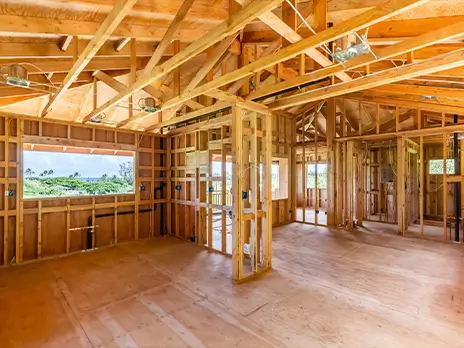
If your house was a total loss, we rebuild it: foundation, framing, roof, envelope, mechanical rough-in, insulation, drywall, and finishes, through permits and final inspection. Rebuild what you had, or change the layout while the lot is clear — we will price both so you are choosing with real numbers.
Fire-damaged roofs almost never get repaired in place. Heat degrades shingles and underlayment well beyond the visibly burned area, and sheathing scorched from below has to come off. We install asphalt, metal, and Class A fire-rated assemblies — worth asking about even where code does not require them.
Vinyl siding melts well below ignition temperature, so radiant heat from a neighboring house is enough to destroy a wall that never caught fire. We replace siding in fiber cement, engineered wood, metal, and vinyl, plus windows, exterior doors, soffit, fascia, and trim.
Whether it is a burned corner of a bedroom or an entire second story, this is the work between demolition and finishes. Framing repair or full reframe, sheathing, insulation, hanging and finishing drywall, and texture matched to the rest of your house.
Heat damages wire insulation inside walls where you cannot see it, and PEX and CPVC deform well below flame temperature. Ductwork that ran through a fire is usually full of soot regardless of whether the metal survived. We coordinate licensed subcontractors and manage their scheduling and inspections.
Cabinets, countertops, tile, fixtures, and appliances. Kitchens tend to be the longest lead item on a rebuild because of cabinet manufacturing times, so we start that selection process early rather than at the end.
Hardwood, engineered wood, luxury vinyl plank, tile, and carpet. Hardwood exposed to suppression water is often salvageable through drying and refinishing if it is addressed quickly. If it has been sitting wet for weeks, it is usually gone.
Doors, casing, base, stair parts, sealing primers over any smoke-affected framing, and paint. This is the stage where a house starts feeling like yours again.
Insurance policies handle detached structures under a separate coverage limit, and homeowners routinely forget to claim them. Shops, sheds, detached garages, fencing, and decks are all in scope for us and all worth documenting in your claim.
If you are rebuilding on a lot that just burned, you are rebuilding in a place that can burn again. Zone 0 clearance in the first five feet, ember-resistant vents, Class A roofing, non-combustible siding and decking, enclosed eaves, tempered glass. None of it makes a house fireproof — it changes the odds, and most of it is cheap now and expensive to retrofit later.
Salvageable belongings need to leave before demolition and cleaning start. We coordinate inventory, pack-out, and off-site storage with specialty contents restoration providers, and we work around your schedule if you are still sorting through things yourself.
Most homeowners we talk to are more worried about the claim than the construction. That is reasonable — the claim determines the budget, and the budget determines everything else. Here is what a contractor can and cannot do for you in Washington, stated plainly, because some companies are vague about this on purpose.
Any contractor who offers to “handle your claim for you” or “fight the insurance company” is either licensed as a public adjuster — in which case ask to see it — or is telling you something they are not allowed to do. A contractor who proposes covering your deductible is telling you exactly how they do business.
Eight stages, in order. You get a named point of contact and regular updates — including the weeks when nothing visible happens because we are waiting on an inspector.
You call, we schedule, we come look. Free — and we do not send a salesperson with a folder of financing paperwork.
We photograph and measure everything, take moisture and soot readings where relevant, and write a line-item scope with pricing.
We meet your adjuster on site and walk the scope together. Agreeing on scope up front prevents most of the fights that happen later.
A written contract with payment tied to completed milestones, not a large deposit up front, plus a projected timeline separating what we control from what we do not.
Pulled through the City of Spokane or Spokane County. We tell you what we are actually seeing rather than promising a date we cannot control.
Debris out, site cleaned, foundation evaluated before anything new goes up.
Rough framing through finishes, with inspections at each required stage and a named point of contact throughout.
We build a punch list together and nothing closes out until it is done. Warranty terms are written into the contract, not implied.
You are not managing a separate demolition company, a smoke remediation company, and a builder, each blaming the other for the schedule.
You know what you are getting and what it costs before anyone picks up a tool.
No large deposit before anything happens. You pay as completed work gets signed off.
If your settlement leaves a gap — which it often does, especially if you were underinsured against current construction costs — apply through the financing link on our site.
Not a call center, not a project coordinator who changes every three weeks. The owner is your point of contact.
WA license #STARCCW791L5, general liability insurance, and a contractor bond. Verify all of it yourself at the L&I contractor lookup.
We are not going to put a price per square foot on this page. Anyone who does is either guessing or selling something, and a number that turns out to be wrong helps nobody. What we can tell you is what actually drives the number on a Spokane fire rebuild.
Material and labor availability is the factor most likely to move your schedule, and it is largely outside any contractor’s control. We will give you a realistic range and update it as we learn more.
What we will commit to is telling you the moment something changes, rather than letting a date quietly slip and hoping you do not notice.
We come out, look at the property, and give you our read on it. If you decide to hire someone else, that is the end of it. No follow-up pressure, no salesperson.
If your address is not listed and you are within reasonable distance of Spokane, call anyway.
Some of this has deadlines. None of it costs you anything to look into.
Federal disaster assistance was authorized for Washington following the August fires. Register at DisasterAssistance.gov or by phone.
DSHS has published ongoing updates for affected residents, including replacement of food benefits lost to the fires and power outages.
Spokane Regional Emergency Communications is the current source for evacuation status and re-entry information.
Your homeowners policy almost certainly covers temporary housing. Open that part of the claim early and keep every receipt.
No. We come out, look at the property, and give you our read on it. If you decide to hire someone else, that is the end of it.
Emergency board-up and securing work is the fastest thing we do. Full rebuilds depend on your claim being settled, permits being issued, and materials being available. Call us early even if your claim is not settled, because scope documentation is useful to have in hand when the adjuster shows up.
Usually yes. Smoke and soot damage to a structure that never caught fire is a covered loss under most homeowners policies. Do not let anyone tell you it is nothing because the walls are still standing. Get it documented.
Yes. We document damage, write line-item estimates in the same format adjusters use, meet them on site, and file supplements when hidden damage appears. We do not negotiate your claim, because Washington requires a public adjuster license for that and we do not hold one.
That is your call and we cannot advise you on it. What we can say is that initial fire estimates frequently miss damage that is only visible after demolition, which is what the supplement process exists for. If you think the offer is low, talk to a licensed public adjuster or an attorney before you sign anything final.
This is common right now, particularly for anyone whose coverage limit was set years ago against older construction costs. Options include checking whether you have extended replacement cost or ordinance and law coverage, adjusting scope, phasing the work, and financing. We offer financing and will talk through the trade-offs honestly.
Depends on the program in effect for your property. Some post-disaster debris programs cover residential structural ash at no cost to the homeowner if you enroll by a deadline. We will look up your situation and tell you which applies. We are not interested in billing you for something the county would have done free.
Yes, and it is worth considering while the lot is clear. Understand that your policy pays to restore what you had. The difference comes out of pocket, and redesign adds permit and engineering time.
Washington license number STARCCW791L5, general liability insurance, and a contractor bond. Verify it at the L&I contractor lookup. Do the same for every contractor who knocks on your door in the next twelve months.
Fair question. The honest answer is that Spokane County lost roughly 700 structures in one weekend and there are not enough local crews to rebuild them all quickly. We are licensed statewide, we have capacity, and we are willing to work out there. If you can get a Spokane contractor you trust on a schedule that works for you, take it. If you cannot, call us.
You do not need to have your claim figured out first. You do not need to know what you want to do yet. If you have a burned or smoke-damaged property in Spokane County, call and we will come out, look at it, and tell you what we see.
Monday through Saturday, 7am to 7pm. Closed Sunday.
Free assessment · No obligation · Financing available