
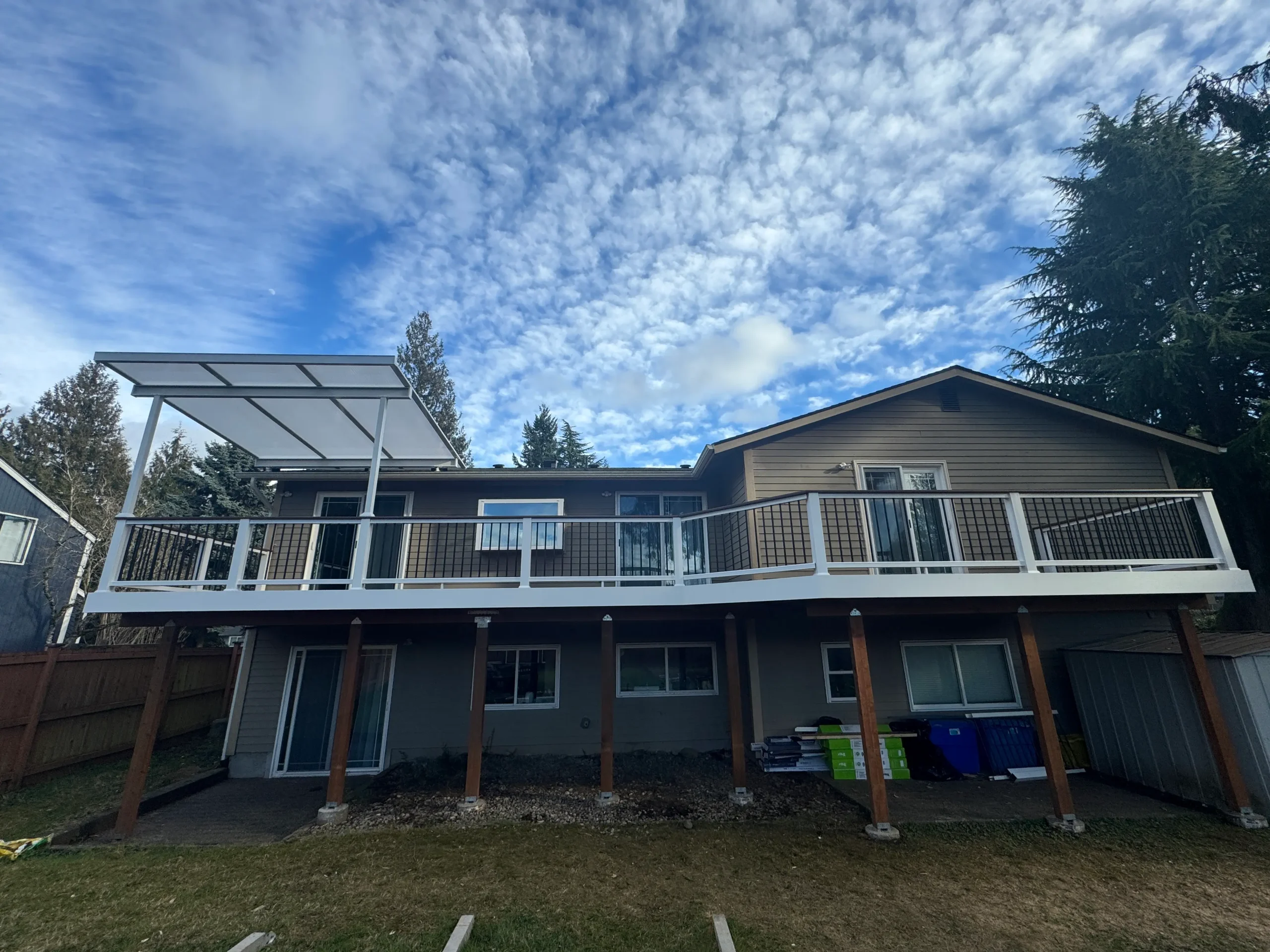
Pairing custom decks with sunrooms and balcony glazing for Bellevue and Mercer Island lake-view homes
If you own a view home on Lake Washington, Lake Sammamish, or Mercer Island, you already know the problem. April through October your deck is the best room in the house. November through March it sits empty under a tarp.
We build a lot of decks on the Eastside, and the conversation almost always lands on the same question: what do we do with this space when it’s 47 degrees and drizzling? For lake-view homes, the answer isn’t a bigger deck. It’s a deck planned together with a sunroom or glazed balcony from the start — one project, not two.
Here’s how that actually plays out.
Why view homes are different
A view lot in Bellevue, Mercer Island, or Medina is not a flat suburban backyard. A few things shift the math:
- The drop. Most lakefront and slope-side homes have a deck cantilevered 8 to 20 feet above grade. That changes your permit pathway and your footing design before you even pick a board.
- The wind. West-facing decks above the water catch a steady evening breeze. Lovely in July. Brutal in February without an enclosure.
- The view itself. You can’t put a solid wall in front of the reason you bought the house. Whatever you build has to disappear when you look through it.
For permit reference, Bellevue requires a building permit and plan review for any deck with a walking surface more than 30 inches above grade. That’s basically every view deck on the Eastside. The full Bellevue building permit requirements are here.
The pairing that actually works
Most homeowners come to us asking for either a deck or a sunroom. The better setup for this climate is both, built as one project with a clear handoff between them.
A typical layout we’ve done on Mercer Island and in West Bellevue:
- A custom composite deck (usually Trex Transcend or TimberTech AZEK) running the full lake side of the house
- One end enclosed as a glazed sunroom or balcony glazing system, usually 12 to 16 feet wide
- Glass or cable railing on the open section so the water view stays uninterrupted
- A sliding or bi-fold door between the sunroom and the open deck
The sunroom becomes your shoulder-season space. The deck stays your summer space. You stop asking either one to do a job it isn’t built for.
For the glazing side specifically, our sunrooms and balcony glazing page covers the systems we use and how they handle the temperature swings you get over the lake.
Materials that hold up over water
Decks within a hundred feet of the lake take more punishment than inland decks. Wetter substructure. More freeze-thaw on the boards. More UV in summer because there is nothing blocking it. A few things we push hard for on view-home builds:
Composite, almost always. Cedar looks great for two summers and then you are staining it every spring forever. Trex Transcend and TimberTech AZEK both carry 50-year limited warranties and they barely move when the humidity off the lake spikes.
Hidden fasteners. Visible screws on a 2,000 square foot deck look fine on day one and look like a rash on day five hundred when half of them have rust rings. Hidden clips cost more up front and pay for themselves in how the deck ages.
Stainless flashing at the ledger. Nobody sees this part. It also decides whether your deck is still attached to the house in twenty years. On lakefront jobs we use stainless because galvanized corrodes faster in the wetter microclimate near the water.
Where the glazing changes everything
A glazed balcony is not a sunroom in the suburban sense. It’s a frameless or low-profile glass system, usually Lumon or similar, that turns part of your deck into a weatherproof room without blocking the view. You open the panels fully in summer and slide them shut when the weather turns.
For lake-view homes this matters because the view stays — frameless glazing is mostly glass and very little frame, so you are not looking through window mullions at the water. The shoulder seasons get longer too. Most clients tell us they get an extra eight to ten weeks of usable outdoor time on each end of summer. And if the glazed space is heated, that square footage may count toward conditioned space for resale purposes, which is a separate conversation worth having with your appraiser.
Bellevue vs Mercer Island — they aren’t the same
These two markets look similar from the outside. They aren’t.
Bellevue’s permit process for additions above 30 inches is well-documented and reasonably fast if your plans come in clean. Mercer Island runs a tighter design review on anything visible from the water or the street, especially for lakefront parcels. If you are planning a deck-and-sunroom combo on Mercer Island, budget an extra four to six weeks for the city before you order materials. We learned that one the hard way on a 2024 job in the East Seattle neighborhood.
We’ve covered the Mercer Island side of the work on our Mercer Island louvered roof page. The Bellevue louvered roof page gets into the structural integrations we’ve done on Bellevue lake-view lots, including the ledger and roof tie-in detail.
What this usually costs
Every project is different. To give you a real number to work with: a 600 square foot composite deck with cable railing on a Bellevue view lot tends to land in the $55K to $85K range, depending on how complex the substructure is. Adding a glazed balcony system across 14 feet of that deck usually adds $25K to $45K, depending on whether you go frameless or framed.
These are not small numbers. They are also not “build a regular deck and pretend the rainy half of the year doesn’t exist” numbers. For most of the lake-view homeowners we work with, the ROI shows up in how often the space actually gets used, not on the appraisal.
How we scope these projects
When someone calls about a view deck on the Eastside, the first conversation is almost never about boards or glass. It’s about how they actually live in the space, or want to. Entertaining in summer? Reading in the morning with coffee? Hosting Thanksgiving? Those answers change which end gets glazed and how much glass we put in.
If you are at the early-thinking stage and want to walk through what your specific lot can support, the easiest path is to request a free quote — we will come out and look. For a deeper look at the deck side, our Seattle deck builders page walks through material warranties, railing options, and the substructure detail we build to on view lots.
The deck is going to sit empty for half the year, or it isn’t. That choice gets made at the drawing stage, not after the fact.