
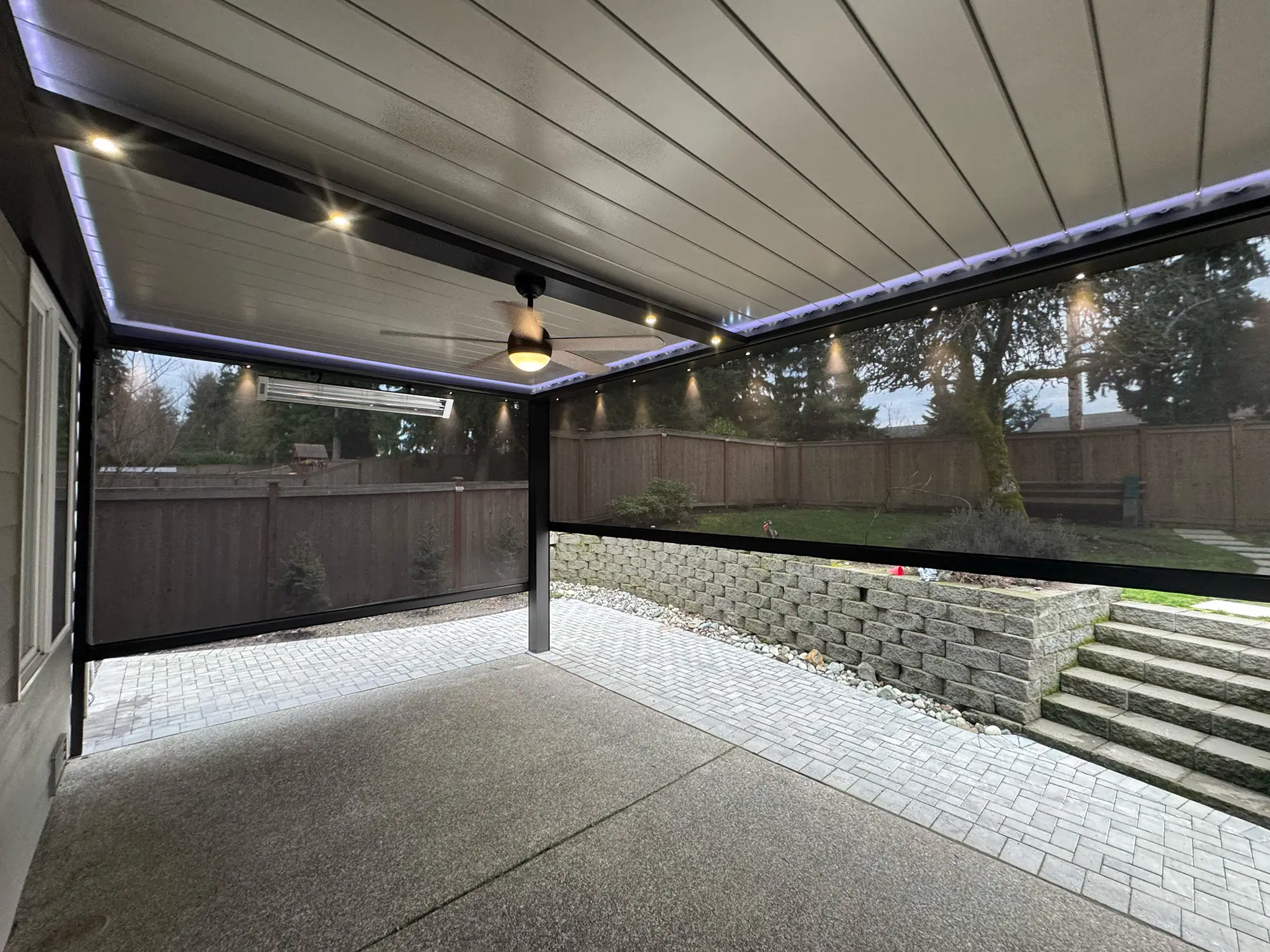
Solar Shades vs. Blackout vs. View-Preserving Fabric: Which Motorized Screen Is Right for Your Seattle Deck?
By Ruslan Bencheci, Owner & CEO, Star Construction WA. Washington State licensed contractor #STARCCW791L5. Updated June 2026.
Almost every screen project we do starts with the same wrong question. People call and ask which motorized screen is best. There isn’t a best one. There’s a best one for your deck, facing the direction it faces, used the way your family actually uses it. The fabric is where that decision lives, and it’s the part most homeowners skip past because they’re focused on the housing color or the motor brand.
So let me walk through it the way I do on a site visit. Three fabric types, what each one actually does once it’s hanging on your house, and how to tell which fits the deck you have.
First, what the fabric openness number means
Shade fabric gets rated by openness factor. That’s the percentage of the weave that’s actual holes versus actual thread. A 5% openness fabric is mostly solid with a little bit of gap. A 14% fabric has wider gaps you can see through more easily. Blackout fabric is 0%, no holes at all.
That single number drives everything else: how much you can see out, how much sun gets through, how much privacy you get after dark. Once you understand openness, the three categories stop sounding like marketing names and start making sense.
Solar shades: the everyday workhorse
Solar shade fabric usually lands somewhere between 3% and 10% openness. This is what we install most often on Seattle and Bellevue decks, and for good reason. It knocks down glare and heat without making you feel boxed in.
Here’s what that looks like on a real deck. West-facing patio in Renton, late afternoon in July. The sun is coming in low and flat, the kind that makes you squint and turns your laptop screen into a mirror. A 5% solar shade cuts that down to where you can sit out there comfortably and still watch the yard. You’re seeing a softened, tinted version of the view, not a wall.
The fabric also blocks a large share of UV, which matters more than people think. We’ve pulled old patio furniture out from behind a season of afternoon sun and seen the difference in fading on the shaded half versus the exposed half. The screens that block UV protect your cushions, your flooring, and your skin while you’re sitting there. If you want the technical side of how these fabrics are engineered, the manufacturer we use, Rainier Industries, publishes the specs on their shade systems.
Daytime privacy is decent with solar shade. People outside have a hard time seeing in when it’s brighter outside than inside. After dark, when your interior lights are on, that flips. They can see in better than you’d like. So solar shade is a daytime privacy fabric, not a nighttime one. Worth knowing before you assume it does both.
Blackout fabric: when you want it gone
Blackout fabric has zero openness. No light through it, no view through it, full privacy day and night. We install this less often on open decks and more often on enclosed or partially enclosed spaces, or where a screen is doubling as a wall.
When does blackout make sense outside? A few situations come up. You’re using a covered patio as a media space and you want it dark enough to actually see the screen at 3pm. You have a hot tub tucked against a property line and you want a real visual barrier when it’s in use. You’ve got a sleeping porch or a guest space where someone needs the room dark in the morning. In those cases blackout earns its keep.
The trade-off is obvious once it’s down: you lose the view entirely and the space gets dim. On a deck where the whole point is looking at the trees or the water, that’s usually the wrong call. I’ve talked more than one client out of blackout on a lake-view deck because they were about to wall off the exact thing they paid for the deck to enjoy. The fix in those cases is usually solar shade for the view side and blackout only on the wall where privacy actually matters.
View-preserving fabric: for the deck you bought for the view
View-preserving fabric runs higher openness, often 10% to 14%. The weave is open enough that looking through it feels close to looking through a clean window screen. You still get glare reduction and a real cut in heat, just less of it than a tighter solar shade gives you.
This is the fabric for the Mercer Island and Bellevue homes where the deck exists because of what you can see from it. Lake Washington, Lake Sammamish, a tree canopy, a city view. On those decks, dropping a 5% shade can feel like putting sunglasses on the whole panorama. The 14% fabric holds the view and still takes the edge off the afternoon.
The cost of that openness is the same privacy lesson in reverse: more openness means people can see through it more easily in both directions, and it lets more sun through. If your west wall bakes from 4pm on, a view-preserving fabric might not cut enough heat on its own. That’s a case where we’ll sometimes pair a louvered roof overhead with view-preserving screens on the sides, so the roof handles the overhead sun and the screens just handle wind and side glare without sacrificing the view.
So how do you actually pick?
Stand on your deck at the worst time of day for sun and ask three things. What direction is the harsh light coming from. Whether the view is the reason you’re out there or just a bonus. Whether you care about privacy after dark or only during the day.
A west or south deck where the view matters and you’re mostly out there in daylight: solar shade, somewhere in the 5% range. A view-first deck on the water where comfort is secondary to the panorama: view-preserving, 10% to 14%. A covered or enclosed space where you want darkness, privacy, or a real barrier: blackout, at least on the walls that need it.
And plenty of decks want more than one. It’s common for us to run a tighter solar shade on the sunny side and a view-preserving fabric where the good view is, all on the same deck, all controlled from the same remote. You don’t have to pick one fabric for the whole space.
A note on planning ahead
If you’re having a deck built and think you might want screens later, tell your builder now. We’ve written before about why new Seattle decks should be designed with motorized screens in mind even if you install them years down the road. Running the wiring and sizing the structure for screens during the build costs almost nothing. Retrofitting it after is where the expense shows up.
Where we work
We install motorized retractable screens and solar shades across Seattle, Bellevue, Mercer Island, Renton, Kenmore, Issaquah, Sammamish, Redmond, Kirkland, Woodinville, Mill Creek, and the surrounding area. Screens are one part of what we do for outdoor spaces. We also build custom decks, install motorized louvered roofs, and add sunrooms and balcony glazing and interior window coverings for homes that want the indoor side handled too.
If you’re trying to figure out which fabric fits your deck, the honest answer is that it’s easier to tell standing on it than guessing from a spec sheet. Request a free quote and we’ll come look at the sun, the view, and the way you use the space, then tell you what we’d put up and why.
Ruslan Bencheci is the owner of Star Construction WA, a licensed Washington State contractor (#STARCCW791L5) building outdoor living spaces across the greater Seattle area.