
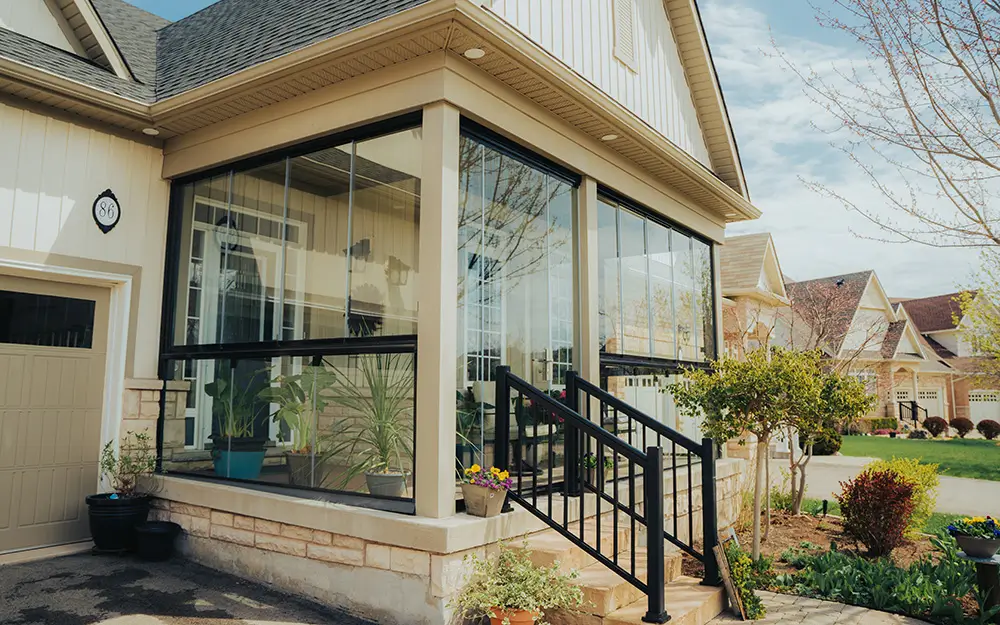
Can You Add a Sunroom to a Townhouse or Condo in King County? Here’s What HOAs Usually Say
By Ruslan Bencheci, Owner & CEO, Star Construction WA Washington State Licensed Contractor #STARCCW791L5 · Updated May 2026
Short answer: yes, you usually can. The longer answer is the part nobody tells you about until you’re three weeks into the process and your HOA board sends back a request for “additional architectural review materials.”
I’ve been building sunrooms and installing Lumon balcony glazing across King County for about twelve years. Probably a third of those jobs have been on townhouses or condos. Every single one had an HOA involved, and every single one ended up approved — but the path looked different every time.
Here’s what I’ve learned, broken down by the questions I actually get asked.
What an HOA can and can’t say no to
The thing most condo owners don’t realize until they’re in it: your HOA generally doesn’t have the authority to ban a sunroom or balcony enclosure outright. What they have is architectural review authority over anything that changes the exterior appearance of a unit. That’s a different thing, and it matters.
In practice, this means:
- They can require the design to match the building (frame color, glass tint, panel style)
- They can require you to submit drawings and a contractor’s license and insurance certificate before work starts
- They can require you to use a specific contractor or product if it’s written into the CC&Rs
- They can require you to pay for any common-element repairs caused by the install
- They usually can’t reject a properly designed enclosure just because they don’t like it
The Washington State Condominium Act gives boards a lot of discretion on aesthetics, but very little discretion on whether you’re allowed to improve your unit at all. If your CC&Rs are silent on balcony modifications, the default in Washington is that you can make them with board approval.
That said — read your CC&Rs before you do anything. Specifically, look for:
- The section on “exclusive use common elements” (this is what your balcony almost certainly is)
- Any clause about “architectural modifications” or “exterior alterations”
- The procedure for submitting an architectural review request
If you can’t find a copy, ask your property manager. They have to give it to you.
Townhouse vs condo — the rules are different
Townhouses owned in fee simple (you own the land under the unit) have a much easier path. The HOA still reviews the design, but you’re not modifying a “common element” — you’re building on your own property. Most King County townhouse HOAs I’ve worked with approve sunroom additions within 30 to 45 days as long as the design respects the building’s architectural style.
Condos are trickier because the balcony is usually a limited common element — you have exclusive use of it, but the association owns it. That’s where additional review steps come in. You’re not just changing your own space; you’re modifying something the building owns.
The good news for condo owners: Lumon balcony enclosures install inside the existing rail without modifying the building envelope. That’s usually the deciding factor for boards on the fence. The system is reversible, it doesn’t penetrate the structure in any meaningful way, and it can come back out if you sell.
The three things HOAs ask for, every time
After about 80 condo and townhouse projects, the approval packets we submit have gotten very predictable. Boards want:
A scaled drawing. Not a sketch. A proper plan view and elevation showing the existing balcony or patio, the proposed enclosure, dimensions, and how it integrates with the building. We provide this as part of the quote.
Contractor credentials. License number (ours is STARCCW791L5, verifiable through the Washington L&I contractor lookup), proof of bond, certificate of liability insurance. The board’s property manager will want originals.
A product spec sheet. For Lumon installations we provide the manufacturer’s technical data — glass thickness, wind load ratings, drainage specifications. Boards eat this up because it answers their unspoken question, which is what happens when this thing fails.
That’s the standard packet. If your board asks for more, it’s usually because something specific about your building requires it — historic district overlay, shared structural element, or an existing HOA dispute that has nothing to do with you.
Permits — when the city gets involved on top of the HOA
This is where people get tripped up. HOA approval and city permit approval are two completely separate processes, and you may need both.
For Seattle properties specifically, the Seattle Department of Construction & Inspections (SDCI) handles building permits. A balcony enclosure on an existing balcony typically doesn’t need a permit because you’re not changing the structure. A full sunroom addition that extends the building footprint always does — see the SDCI’s Construction Permit – Addition or Alteration page for the official criteria.
For Bellevue, Mercer Island, Renton and the other King County municipalities, the rules are similar but the paperwork differs. We’ve pulled permits in all of them. As a rough guide:
- Balcony enclosure on existing rail, no structural change: usually no permit
- Three-season sunroom on an existing covered patio: usually a subject-to-field-inspection permit
- Full sunroom addition that extends the building footprint: full building permit, plans review, the works
For condos, the HOA usually wants to see the permit before they sign off on construction. For townhouses, the city usually wants to see HOA approval before they issue the permit. It’s a chicken-and-egg problem we’ve gotten very good at sequencing.
Real timelines from real projects
These are pulled from jobs we finished in 2024 and 2025, with names changed:
A two-bedroom condo in Belltown, 14th floor, north-facing balcony. Lumon enclosure, no structural changes. HOA approval took 21 days. No city permit required. Install was one day. Total from first call to finished install: 9 weeks.
A townhouse in Bellevue, end unit, three-season sunroom off the back. HOA approval took 38 days because the design committee wanted a second revision on the roofline. City permit was another 28 days. Manufacturing was 5 weeks. Total: about 4 months.
A four-unit condo building in Capitol Hill where the entire owner-occupied block wanted matching Lumon enclosures across all four balconies. HOA approval took 6 weeks but we got a “blanket” approval covering all four units. Phased install over two weekends. Total from first call to last unit finished: about 5 months.
The bigger the project, the longer the HOA piece, but the smoother the install once approved.
What kills HOA approvals
Three things, in order of frequency:
Incomplete submissions. Boards meet monthly. If your packet is missing the insurance certificate, you’ve just lost 30 days. We submit complete packets; we don’t let owners DIY this part.
Design that ignores the building. A bright white frame on a brown-and-grey building. A glass tint that doesn’t match the neighboring units. A pitched roof on a flat-roofed building. Easy to avoid if you actually look at the building before designing.
Asking forgiveness instead of permission. I’ve had two homeowners over the years try to install without approval, then call us mid-job because the HOA sent a stop-work letter. Both ended up paying for the install twice — once for the original, once to remove and redo it the way the board wanted. Don’t be those people.
When the answer is actually no
There are a few situations where I’ll tell a prospective client to walk away:
- The CC&Rs explicitly prohibit balcony modifications (rare, but it happens in some older Seattle co-ops)
- The building is in an active legal dispute between owners and the board (you’ll be Exhibit A in someone’s lawsuit)
- The balcony has structural issues the board hasn’t disclosed (we walked away from a job in Lynnwood last year for exactly this — the rail wasn’t safe to load)
If any of those apply to you, no contractor worth hiring will take the job. That’s a feature, not a bug.
Where to start
If you’re thinking about this for your King County townhouse or condo, here’s the order I’d suggest:
- Read your CC&Rs. Find the architectural review clause.
- Call your property manager and ask what the approval process looks like.
- Get a written quote from a licensed contractor so you have real drawings to submit.
- Submit the HOA packet.
- Pull city permits if required, in parallel with HOA review.
We do free consultations across Seattle, Bellevue, Mercer Island, Renton and surrounding King County. If you want a written quote and the drawings you’ll need for your HOA packet, request a free quote here or call (206) 600-2225. You can see previous condo and townhouse projects in our gallery, and if you’re also considering exterior work like a custom deck, we can usually phase both into one HOA submission to save you a round of paperwork.
Questions about your specific building or board? Get in touch — happy to look at your CC&Rs before you commit to anything.