
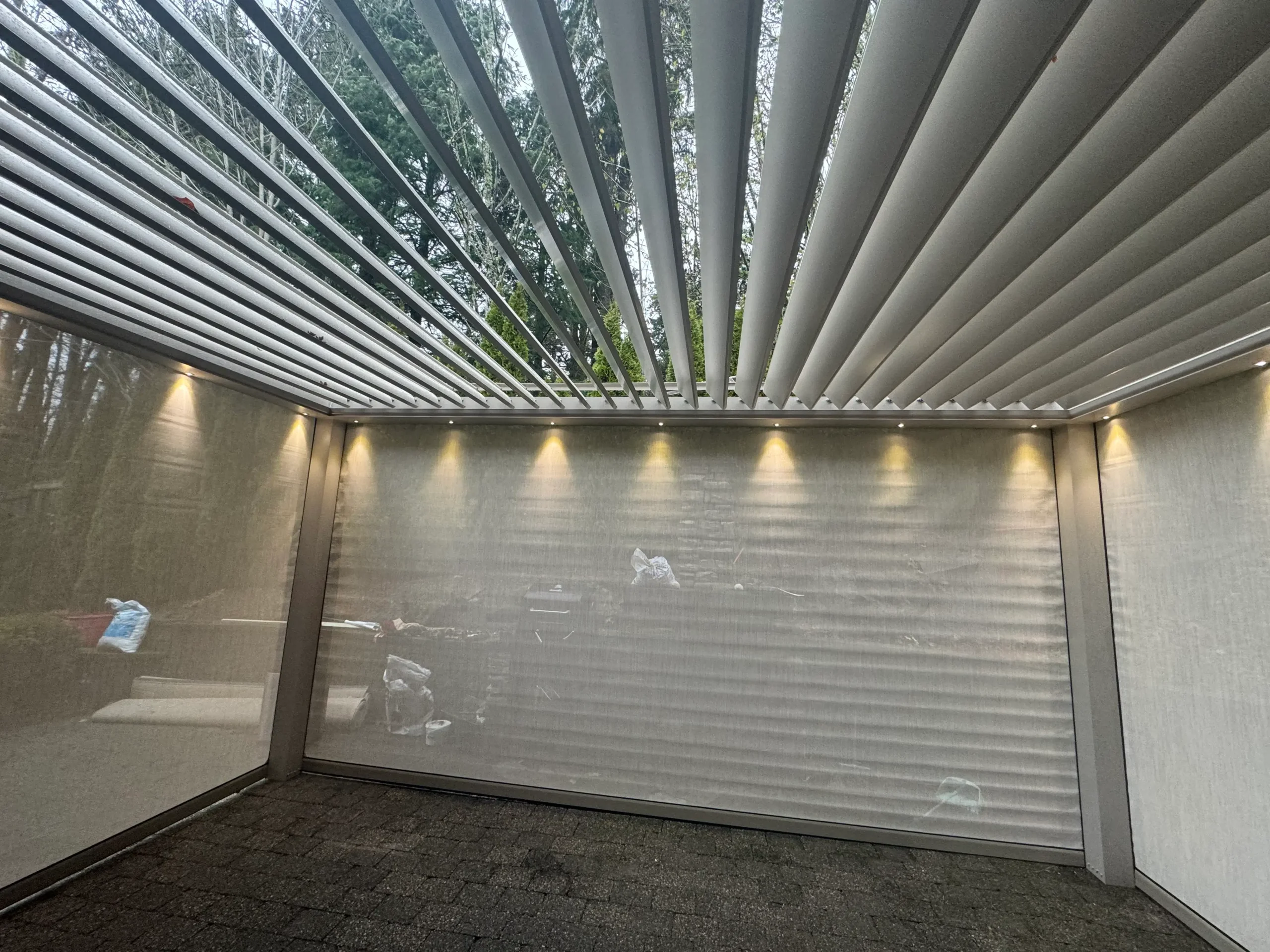
Solar Screen Openness Factors Explained: 1%, 3%, 5%, 10% and Which We Recommend for West-Facing Seattle Decks
By Ruslan Bencheci, Owner & CEO, Star Construction WA. Washington State licensed contractor #STARCCW791L5. Updated June 2026.
Almost every screen quote I write starts with a number people don’t understand yet. They’ve seen “5% openness” on a fabric sample or a competitor’s site, nodded along, and have no idea what it actually means for the deck they’re standing on. So let me explain it the way I explain it on a site visit, with a west-facing Seattle deck in mind, because that’s the orientation where this choice matters most.
Openness factor is the percentage of the fabric that is literally open. Holes, in other words. A 5% fabric is 5% gaps and 95% yarn. Lower number, tighter weave, fewer holes, more sun and heat stopped, less you can see through it. Higher number, looser weave, more view, more light, more heat getting past. That’s the whole trade. Everything else is detail.
The reason it gets confusing is that the same number is doing two jobs at once. It tells you how much heat and glare the fabric blocks, and it tells you how much you’ll still see through it. You can’t max out both. A fabric that blocks almost everything also hides almost everything. So the right openness isn’t the “best” one, it’s the one that fits how your deck faces the sun and how you actually use the space. If you want the full rundown of fabric types and how they fit into a motorized system, our solar shades service page covers the hardware side.
Why west-facing changes the math
A north deck barely needs to think about this. A west deck does. From about 3pm on through a Seattle summer, the sun drops low and comes in flat, straight at you, under any roof or overhang you’ve got. That low afternoon angle is exactly what a fixed cover can’t stop and what an exterior screen is built for. I wrote about the energy side of this in detail over on the real energy savings of motorized screens on west-facing decks, so I won’t repeat all of it here. The short version: west is where the screen earns its money, and west is where openness factor stops being trivia and starts being the difference between using the deck at 6pm or going inside.
The federal Energy Saver guidance backs up the basic principle, that exterior shading stops solar heat before it reaches the glass, which is why it outperforms anything you hang on the inside. You can read their plain-language breakdown of energy-efficient window coverings if you want the building-science version. On a west deck, that “stop it before it hits” effect is the entire point.
What each openness factor actually does on a deck
Here’s how I talk through the common options when someone asks which one to pick.
10% openness. The most open of the common fabrics. Best view, most light, breeziest feel. It cuts glare and takes the edge off the heat, but on a hard west exposure at 5pm in July, it’s the one that lets the most through. I steer people here when the view is the priority and the sun is a secondary annoyance, or for decks that don’t catch much direct afternoon light.
5% openness. The one I recommend most often for Seattle decks, and it’s not close. It blocks a real amount of heat and glare while still letting you see your yard, the lake, whatever you’re paying Seattle prices to look at. For a covered west-facing deck that wants shade in the evening without feeling boxed in, this is usually the answer. It’s the middle of the road in the literal sense, and the middle is where most people actually live.
3% openness. Tighter weave, more privacy, more heat blocked, view starts to cloud over. Good for a west deck that takes a brutal late-day beating, or where you’ve got neighbors close enough that you want to see out without them seeing in. You give up some clarity to get there. Plenty of homeowners think that’s a fair trade on the west side.
1% openness. Nearly closed. This is for the spot where the sun is relentless and you mostly want it gone, or where privacy matters more than the view. You’ll still get daylight, but you’re not looking through this fabric the way you would a 5%. I don’t spec it often for a deck people want to look out from, but for a west-facing wall of a screened room, it has its place.
Worth saying plainly: none of these are blackout. Solar screen fabric is a mesh, so even the 1% reads as a tint from inside, not a wall. If you actually want a west room to go dark, that’s a different fabric and a different conversation, and we install that too.
Color matters more than people expect
Two screens, same 5% openness, different colors, will not behave the same. A dark fabric, charcoal or black, holds the view better. You see through it more clearly because your eye reads the shadows past it. It also absorbs heat rather than bouncing it, and it cuts glare harder. A light fabric reflects more heat off the face of the screen and reads brighter inside, but you lose a little crispness looking out.
On a west deck I usually lean toward a darker 5% when the view is the whole reason the deck exists. You keep the Lake Washington sightline and still knock the glare down. That’s a judgment call I’d rather make standing on your deck at the right time of day than guess at from an office, which is part of why we measure on site instead of selling off a chart.
How openness fits the rest of the system
The fabric is one decision inside a few. The housing style, square or rounded, changes how the whole thing reads against your house, and I get into that over on the blog where I broke down matching Rainier power screen housings to your home’s architecture. The structure matters too. If you’re pairing screens with a roof that opens, a louvered pergola handles rain and overhead sun while the screens handle the low west glare, and openness factor only governs that second job.
And if you’ve decided the heat problem is really an indoor-window problem rather than a deck problem, exterior screens may not be your answer at all. Interior window coverings solve a different thing. Exterior wins on heat every time, but interior wins on certain light and privacy situations, and I’d rather tell you that up front than sell you the wrong product.
So which one should you get
If you’ve got a covered west-facing deck in Seattle or on the Eastside and you want one answer to start from: a 5% openness in a darker color is where I’d point most people. It blocks enough of that low afternoon sun to make the deck usable when you actually want to be out there, and it keeps the view you bought the house for. From there we adjust. More privacy or a harsher exposure pushes you toward 3%. View above all else pushes you toward 10%.
The honest version is that I can’t finish this answer in a blog post. The right openness depends on your roof, your overhang depth, which direction “west” really points on your lot, and what time you sit outside. That’s a site visit, not a chart.
If you want a real recommendation for your deck, request a free quote and we’ll measure on site and tell you which fabric fits. Or call us at (206) 600-2225.
Ruslan Bencheci is the owner of Star Construction WA, a Washington State licensed contractor (#STARCCW791L5) building decks, louvered pergolas, and motorized solar shades across Seattle and the Eastside out of our Bothell shop.