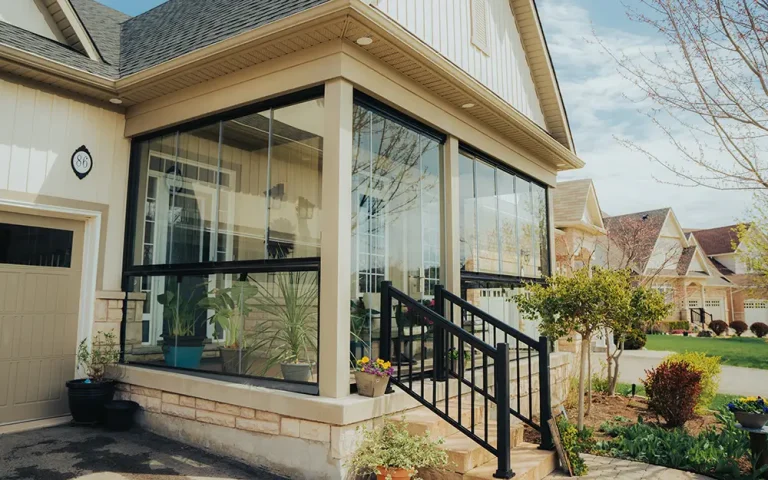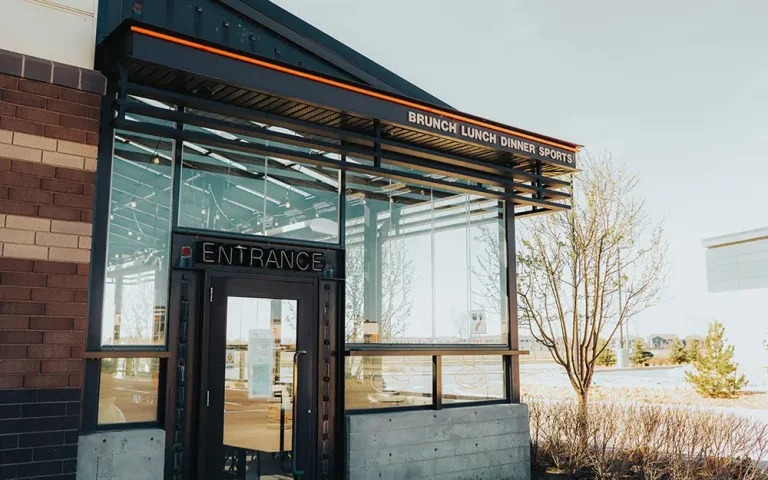
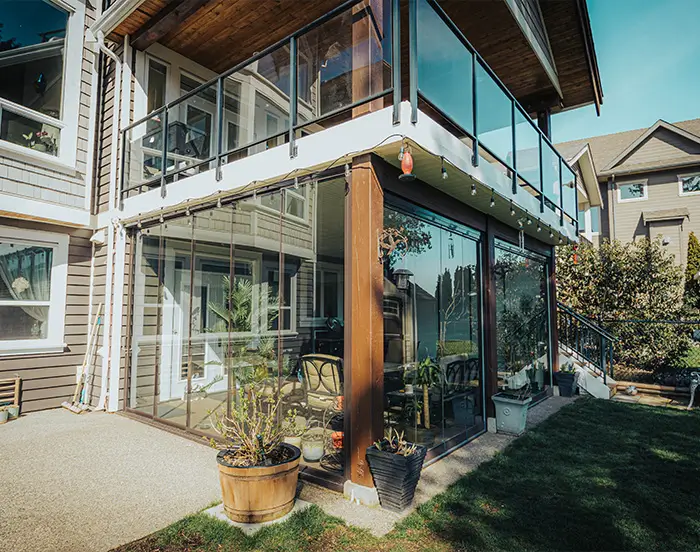
If your balcony faces I-5, sits within earshot of the SR-520 bridge joints, or lies under a Sea-Tac approach, you may be thinking about glass as much for the noise as for the rain. Before you spend money on it, it helps to know what frameless glazing does to that sound and where it stops helping.
The short answer
Closing a balcony with frameless glass usually makes traffic noise noticeably quieter. It makes aircraft noise less intrusive without making it go away.
Lumon’s lab testing of its standard balcony glazing and railing system shows a reduction of up to 20 decibels. Independent acoustic testing of Lumon’s retractable glazing, published by Lumon Canada, measured up to 13 dBA of outdoor-to-indoor noise reduction with enhanced sealing. A typical Seattle balcony with the standard ventilation gaps will land below both numbers.
Even the lower end is easy to hear. Most people hear a 10 decibel drop as roughly half as loud, and they notice a 5 decibel drop without trying. Tire hiss, engine noise, voices and construction come down the most. The low rumble of a jet taking off comes down the least.
What a decibel drop sounds like
Decibels are logarithmic, so the numbers don’t add up the way inches do. A 3 decibel change is about the smallest difference most people can pick out. Five is clearly noticeable, and at ten the sound seems about half as loud.
The Washington State Department of Transportation uses the same scale when it decides where to build freeway walls. According to WSDOT’s guide to noise walls and barriers, a wall has to cut noise by at least 7 dBA to be considered reasonable, and the department aims for 10. Homes directly behind a wall often hear the noise cut in half, but the benefit shrinks with distance and is negligible past about 500 feet. WSDOT treats 66 dBA as the level where two people standing three feet apart can no longer talk at a normal volume, and it doesn’t fund noise changes to private homes.
WSDOT also notes that simply blocking the line of sight to a road usually buys about 5 decibels. If you can see the traffic from your patio chair, nothing is blocking it. That’s why a 9th-floor balcony a few blocks off the freeway gets little from a wall built for the houses at street level. Glazing puts the barrier where you sit, and a well-sealed install can reach the range a noise wall gives the house right behind it.
Why your balcony won’t match the lab number
Our standard Lumon installs leave 2 to 3 millimeter gaps between the panels on purpose. Those gaps let the space breathe, so it doesn’t fog up and grow mildew through a Seattle winter. (We cover that in detail in our post on condensation in Seattle sunrooms.) Sound also slips through gaps. Tighter sealing gives you more quiet and less airflow, and for anyone whose main complaint is noise, that trade-off is worth talking through on site.
Glass type matters as well. Lumon builds with tempered or laminated glass depending on the system. Laminated glass has a plastic layer between two sheets that absorbs vibration, and Lumon says it blocks noise better than tempered glass.
Glazing only closes what it covers. If the balcony above doesn’t fully cap yours, if there’s an open strip at the slab edge, or if one side is a railing instead of a wall, sound goes around the glass. We look for those paths when we measure.
The type of noise limits what any glass can do. Lumon says its glazing works best on mid- and high-frequency sound like traffic, voices and street noise, and that deep, low sound is harder for any glazing system to block.
I-5: a steady roar, and the best case for glass
Freeway noise is mostly tires and engines blending into one continuous roar. Most of that sound sits in the frequencies glass handles well. If you live in one of the condo and apartment buildings along the corridor, from Northgate down through Roosevelt, Eastlake and First Hill, this is the noise glazing helps with most.
Height changes the picture. Freeway walls are designed for people on the ground. Once your balcony is above the top of the wall and you can see the lanes, the wall is no longer between you and the cars. Upper floors facing the freeway can be louder than the floors below them for that reason, and they usually get the most out of closing the balcony.
SR-520: tire hiss on the bridge, clunks at the joints
SR-520 sounds different. WSDOT says the grooved pavement on the floating bridge that opened in 2016 reduces tire noise. The complaints that came in after it opened were about the large expansion joints at the east and west ends, where tires hitting the joints make a thump. WSDOT found that the quieter pavement makes the joints stand out more, even though the new joints measure quieter than the old bridge’s. The City of Medina has been working with WSDOT and the state legislature on the issue.
A sharp, repeated clunk is harder to tune out than a steady hum, even when it measures lower. Glazing takes the edge off it, and the higher click fades more than the deeper thump from heavy trucks. In Montlake, near Portage Bay and on the Medina and Clyde Hill side, expect the joint noise to fade but stay audible.
WSDOT has said the new Portage Bay Bridge will carry a permanent 45 mph limit, partly to cut tire noise. The bridge is being rebuilt now, and WSDOT expects to finish in 2031. Until then, glazing also helps with piledriving, saws and backup alarms, which are higher pitched than the road noise you’ll be left with afterward.
Sea-Tac: which planes you hear depends on the wind
Sea-Tac’s runways run north to south, and planes take off and land into the wind. The Port of Seattle says the airport runs in south flow about 65 percent of the year, mostly during the cooler, cloudier months. In south flow, arrivals come in over the neighborhoods north of the airport and departures climb out to the south. On clear days the wind usually swings around and the pattern reverses.
So if you live north of the airport, in Tukwila, Georgetown or on Beacon Hill, you mostly hear arrivals through the gray months and departures on sunny days. Des Moines and the cities south of the airport get the opposite.
Jet noise is the hardest case for glass. Engines put out a lot of low-frequency energy, which is the part glazing blocks least, and the sound comes from above. On a condo balcony, the slab overhead does part of the work and the glass closes the sides. On a deck enclosure with a glass or acrylic roof, the roof is the main thing between you and the plane. Arrivals fly at lower power than departures and are easier to soften. A departure will still be audible behind glass, and you’ll feel its rumble more than you hear its whine.
The rooms behind the balcony get quieter too
For most condo owners the biggest change shows up in the bedroom or living room behind the balcony. Lumon’s own explanation is that lowering the noise on the balcony lowers it inside the unit too. With the glazing closed, street noise has to pass through two layers of glass with an air space between them before it reaches your bed.
It also changes summer nights. You can leave the slider open for air and still have a layer of glass between you and the road.
If a bedroom window on another wall also faces the noise, that window becomes the weak spot once the balcony is closed. Replacing it with a better-insulated unit can matter as much as the glazing, which is why we also do window and door installation.
How to measure your own noise before you spend money
You don’t need an acoustic consultant to get a useful baseline. NIOSH, the federal agency for workplace safety research, publishes a free Sound Level Meter app for iPhone. A phone isn’t a lab instrument, but it’s good enough for a before and after comparison.
Take readings on the balcony, and inside with the balcony door shut, standing in the same spots each time. Do it during the weekday morning commute and again late in the evening. If planes are your problem, take one set on a gray day in south flow and another on a clear day after the flow has flipped. Write the numbers down. After the glass goes in, repeat the same readings at the same times of day.
Phone meters usually report dBA, a scale that discounts low frequencies. A jet or a loaded truck can feel louder than the reading suggests, and for those sources the improvement can look better on paper than it sounds in the room.
What we check when noise is the reason you’re calling
If noise is your main complaint, tell us at the consultation, because it changes what we look at:
- which way the balcony faces the source, and whether you can see it from where you sit
- your floor height compared with any nearby noise wall
- every gap around the opening, including the slab edge, the ceiling and the side returns
- which glass options are available for your opening
- your association’s rules on exterior changes, which we covered in our post on adding a sunroom to a condo or townhouse in King County
- whether a window or door is the real weak point
Nobody can honestly promise a decibel figure before seeing the site, because the gaps and the building matter as much as the glass.
Common questions
Will balcony glazing make my condo soundproof?
No. It closes the balcony against weather and cuts noise, but frameless retractable glass with ventilation gaps is not a soundproof wall. Expect a clear reduction in traffic noise and a smaller one for aircraft.
Is laminated glass worth it for noise?
Lumon says laminated glass is particularly effective against noise because its plastic layer absorbs vibration. Whether it’s offered depends on the system and the opening, so ask about it at the measure if noise is your priority.
Can the gaps be sealed to make it quieter?
Tighter seals do help, and that’s how the independent test reached 13 dBA. The same gaps keep a glazed balcony from fogging and growing mildew in our climate, so sealing them is a trade-off we decide with you, balcony by balcony.
Will I still hear planes from Sea-Tac?
Yes. Glass reduces the higher-pitched part of jet noise well and the low rumble less. Arrivals are easier to soften than departures because the engines are working less hard.
Do I need HOA approval to glaze a condo balcony?
Usually. Glazing changes how the outside of the building looks, so most associations want to review it first. Our post on turning a Seattle balcony into a sunroom explains what’s possible on most balconies and what isn’t.
Tell us what you’re hearing
We install Lumon balcony glazing and sunrooms across King, Snohomish and Pierce counties. If you’re comparing sunroom contractors in Seattle, bring your noise readings to the consultation and we’ll give you a straight answer about how much glass will help on your balcony. You can request a free quote or call (206) 600-2225.