
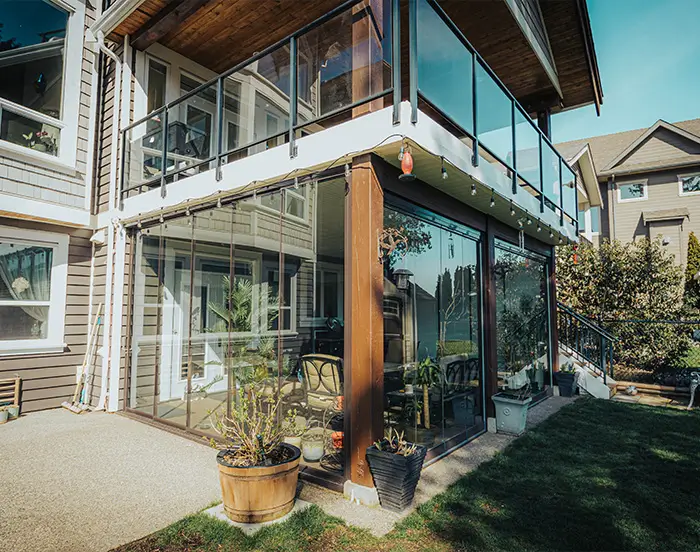
Can You Turn a Balcony Into a Sunroom? What’s Possible on Seattle Balconies and What Isn’t
If your balcony furniture spends October through May under a tarp, you’ve probably wondered about this. The answer is usually yes, with some big asterisks.
Most Seattle balconies can be glassed in so you can actually use them when it rains, which around here is most of the time. Turning one into a heated room that counts as part of your home is another story. That’s rarely possible, and the reasons have to do with building rules, structure and moisture. Before you call anyone for a quote, figure out which of those two projects you’re after.
“Balcony sunroom” can mean three different projects
The one most people end up with is retractable glazing. Frameless glass panels run along the railing up to the ceiling or the balcony overhead, and they slide and fold against one side when you want the air back. Nothing gets heated or sealed. Think of it as a covered porch with walls you can put away.
The second option is a fixed enclosure. Aluminum or vinyl frames hold glass or polycarbonate, usually with a door and a couple of windows that open. Sometimes it’s cheaper, and it can feel more solid. The trouble is that it holds moisture in, and in a city this damp that tends to catch up with you.
The third is a full conversion. That means insulated walls, double-pane windows and heat, with the balcony folded into the living room. In a condo or apartment building, you can mostly forget about this one. It changes the exterior wall and adds floor area. That brings in permits, the energy code and an engineer, plus a vote by your association. On a house with a second-story deck it can be done, but at that point you’re building an addition and paying for one.
So for most people reading this, glazing is the realistic option.
Signs your balcony is a good candidate
Start by looking up. Glazing systems need something to attach to at the top, usually the underside of the balcony above you or a roof overhang. If you’re on the top floor with open sky overhead, you’d need to build a roof first, and the project gets a lot bigger and pricier.
Then look at the railing. The panels usually mount on or just inside it. Some installers, such as Bothell-based Lumon dealer Star Construction WA, mount the panels from inside the rail. On a sixth-floor unit, that’s a lot easier than hanging scaffolding off the side of the building.
Drainage matters more than most people expect. Your balcony was designed to shed water, and whatever you put around it has to leave those drains working and keep water from pooling against the building wall. Better frameless systems leave small gaps between panels and let water drain out the bottom of each one. The space breathes even when the glass is closed.
Last, check for equipment. A lot of newer Seattle buildings put heat pump condensers or mini-split units out on the balcony. Those need open air to work. If you box one in, it struggles, so you’d have to move the unit or leave the panels near it open. Plenty of people don’t find this out until the installer points at the unit during the first visit.
Things you can’t do once it’s enclosed
Grilling is the obvious one. The Seattle Fire Department warns that carbon monoxide can build up to deadly levels when you grill in an enclosed space. Slide all the panels open and you’re more or less back outdoors. With them closed, keep the grill off the balcony.
The other thing is heat. Single-pane glass with ventilation gaps is meant to stay unheated, so the space won’t work as a spare bedroom in January. A small infrared heater or a thermal rug takes the chill off in spring and fall. Push past that and you’ll get condensation on the glass and mildew in the corners, which defeats the point.
Condos, HOAs and landlords
Your balcony probably isn’t entirely yours. Most condo documents treat it as a limited common element: you get to use it, but the association controls how the outside of the building looks. You’ll need board approval. Some boards will only sign off on one specific system, color and layout so the building doesn’t end up looking like a patchwork. Ask whether your board already has a standard before you collect quotes. If it doesn’t, proposing one for the whole building can go more smoothly than asking for a one-off.
Renters need written permission from the landlord. Most say no unless they’re paying for it themselves, which does happen occasionally as a building-wide upgrade.
Do you need a permit in Seattle?
It depends on what changes. Glazing that attaches to an existing covered balcony without altering the structure often doesn’t need a building permit. Changing the structure, adding floor area or heating the space almost certainly does, and a full sunroom addition always will. Seattle, Bellevue and the other Eastside cities don’t all handle this the same way, so your contractor should check with the local jurisdiction before quoting you a price.
What it costs
Most of the price comes from how much glass you need. Corners and railing changes add to it. Star Construction WA lists typical residential balcony enclosure jobs at between $12,000 and $28,000 in the Seattle area, and full sunroom additions starting around $45,000. The company says its panels are made to measure and usually take four to six weeks to produce, and that most single balconies go in within a day.
Lumon, the Finnish company whose panels Star installs, is one of the better-known names in frameless glazing. It isn’t the only one, and framed systems from other makers can come in cheaper. Whoever you talk to, get the quote itemized and in writing, and ask how their system deals with drainage and condensation. How they answer will tell you a lot. In Seattle, that detail decides whether an enclosure lasts decades or rots out its frame in ten years.
Will it add value?
Probably not in the way an appraiser measures it. A glazed balcony stays unheated and ventilated, so appraisers tend to treat it as an amenity, closer to a covered patio than to living space. The payoff is more personal. Seattle gets rain on about 150 days a year, and a glazed balcony stays dry through most of them. You can drink your coffee out there in March, or keep your plants alive through November.
If added square footage is what you want, you’re looking at a sunroom addition or a remodel. That’s a bigger budget and a real permit. In most condo buildings it’s also a much tougher conversation with the board.
Quick answers
Can I put a sunroom on my apartment balcony?
Only with your landlord’s written okay, and most won’t give it. Condo owners have better odds, as long as the board approves.
Does balcony glazing cut street noise?
Yes, noticeably, once the panels are closed. The ventilation gaps mean it won’t be as quiet as a sealed window.
Can I enclose a balcony with nothing above it?
Not with standard glazing. You’d need a roof or cover first.
Can I heat it?
A little. A small infrared heater is fine, but heating it like a bedroom leads to condensation problems.