
Interior blinds or exterior solar shades? Answering the question our Seattle clients ask most
By Ruslan Bencheci, Owner and CEO, Star Construction WA. Washington State licensed contractor #STARCCW791L5, fully bonded and insured. Bothell, WA.
This is the call I take more than any other. Someone’s back room gets too hot, or the afternoon glare washes out the TV, and they’ve been shopping for blinds online. Then a friend mentions outdoor shades, and now they’re confused about which one they actually need. It’s a fair question, and the honest answer is that these two products solve different problems. Pick the wrong one and you’ll spend real money without fixing the thing that bugged you in the first place.
We install both. I have no reason to push you toward one, so here is how I sort it out when a client asks me on site.
The one rule that decides it
If your problem is heat, you want the shade on the outside. If your problem is light and privacy, interior blinds usually do the job. That’s the whole thing in one line, and almost every case comes back to it.
Here’s why. Sunlight hits your window and turns into heat. An exterior solar shade stops that sunlight before it ever touches the glass, so the heat stays outside where it belongs. An interior blind only sees the sun after it has already passed through the window and entered the room. By then the heat is in the house, and the blind is fighting a fire that’s already lit. It can’t win that fight the way an exterior screen can.
This isn’t just my opinion from job sites. The U.S. Department of Energy’s Building America research measured it: exterior window screens were shown to reduce solar heat gain by about 46 percent, while interior screens managed about 14 percent (DOE Building America Solution Center). Same idea, opposite side of the glass, and the outside wins by a wide margin.
When interior blinds are the right call
I don’t want to talk anyone out of blinds. For a lot of rooms they’re exactly right.
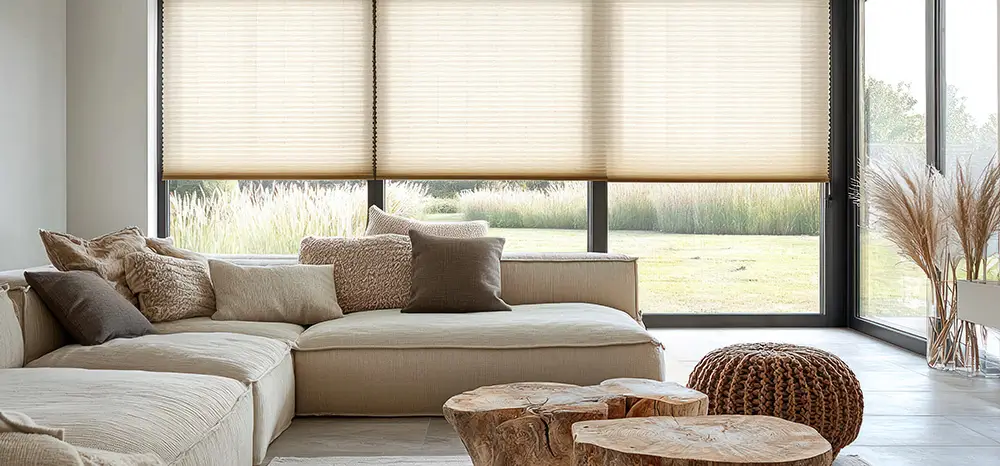
If you mainly want privacy at night, blinds handle that cleanly. If you want to dim a bedroom for sleep, blackout cellular shades on the inside are a great answer. If the room faces north, or it’s shaded by a neighbor’s house or a tree, heat isn’t really the issue, so there’s no reason to spend on an exterior system. And blinds give you fine control over light through the day in a way that’s nice to live with. We carry roller shades, wood blinds, cellular shades, and blackout options, and you can read more on our interior window coverings page.
Blinds are also protected from the weather and are simpler to install, which usually makes them the cheaper starting point. If your problem is genuinely a light and privacy problem, that’s money well spent.
When exterior solar shades are the right call
Now the flip side. If a room bakes in the afternoon, if the glare off the water or the low sun makes the space unusable from about 3pm on, or if you’re watching your furniture and flooring fade, that’s a heat and UV problem. Interior blinds will help a little and disappoint you a lot. This is where outdoor solar shades earn their keep.
West-facing rooms in Seattle are the classic case. From mid-afternoon on, the sun comes in low and flat, straight at the glass, and it slides right past anything mounted inside. An exterior screen on a motor drops down over the outside of the glass, filters most of the UV, cuts the glare, and takes the heat load off the room behind it. You still see out. Pick the right fabric openness and it reads like a light tint on the view, not a wall.
The fabric rides in side tracks, so it stays taut in wind instead of flapping, and it rolls up into an aluminum housing when you don’t want it. I’ve installed these through enough Puget Sound summers and winters to know they hold up here.
The honest answer for a lot of homes: both
Plenty of our clients end up with exterior shades on the two or three problem windows and interior blinds everywhere else. That’s not a compromise, it’s just matching the product to the room. The west-facing living room that overheats gets an outdoor screen. The street-facing bedroom that needs privacy gets a blackout cellular shade. Each window gets what it actually needs, and you’re not overpaying to put an expensive exterior system on a window that was never too hot to begin with.
When we do the free on-site measure, we walk the house and tell you, room by room, which is which. Sometimes the answer is all interior. Sometimes it’s one exterior screen and you’re done. We’ll tell you straight either way.
What about cost?
There’s no honest single number, because it rides on the size of the opening, the fabric, and how a motor gets wired. As a rough ordering, interior blinds are usually the lower starting point, and a motorized exterior screen costs more because it’s built to order and powder coated to live outside. But cost per window is the wrong way to think about it. The right question is which product solves your problem. Paying less for a blind that doesn’t fix your heat problem isn’t saving money, it’s just spending it on the wrong thing.
Frequently asked questions
Are outdoor solar shades better than interior blinds for heat?
Yes. Exterior shades stop the sun before it reaches the glass, so they block far more solar heat than anything mounted inside. DOE research puts exterior screens around 46 percent solar heat reduction versus about 14 percent for interior screens. For light and privacy, interior blinds are the better and often cheaper choice.
Do you install outdoor solar shades near me?
If you’re in Seattle, the Eastside, or anywhere from Everett down to Bonney Lake, yes. Our crew is based in Bothell and we cover Seattle, Bellevue, Mercer Island, Kirkland, Redmond, Sammamish, Issaquah, Renton, Kenmore, Woodinville, and Mill Creek. We measure on site and quote for free.
Can I use interior blinds and exterior solar shades together?
Absolutely, and a lot of homes do. Exterior shades handle the windows with a heat or glare problem, and interior blinds handle privacy and light control on the rest. During the on-site measure we’ll tell you which windows need which.
How much do outdoor solar shades cost in Seattle?
It depends on the width of the opening, the fabric, and the wiring. A single window screen costs much less than a wide patio span with blackout fabric. Call (206) 600-2225 and we’ll measure on site and give you a real number.
Get a free quote
Not sure which one you need? That’s the normal state of things when you call us, and sorting it out is the easy part. Call (206) 600-2225, email [email protected], or request a free quote online. We’re a Washington State licensed contractor (#STARCCW791L5), fully bonded and insured, and every exterior screen is built to order and powder coated in house at our Bothell shop. If you’d rather cover the whole space, ask us about pairing shades with an acrylic patio cover.
Star Construction WA
2220 164th Pl SE, Bothell, WA 98012
(206) 600-2225
[email protected]
Serving Seattle and the Eastside. Monday to Saturday, 7am to 7pm.