
Outdoor Solar Shades vs. Awnings vs. Acrylic Covers: a Seattle Homeowner’s Honest Comparison
By Ruslan Bencheci, Owner and CEO, Star Construction WA. Washington State licensed contractor #STARCCW791L5, fully bonded and insured. Bothell, WA.
People call us asking for the best way to shade a deck in Seattle, and I never have a clean answer for them. There isn’t a best one. There’s a best one for your deck, the direction it faces, and how your family actually sits out there. I’ve installed all three of these systems across Seattle and the Eastside, and each one solves a different problem. Some solve two. None of them solves all of them.
So instead of selling you on one, here is how I explain the difference when I’m standing in somebody’s backyard with a tape measure. If you already know you want fabric screens, our outdoor solar shades page covers fabrics, colors, and housing styles in detail. This post is for the person who hasn’t decided yet.
The three systems, in plain terms
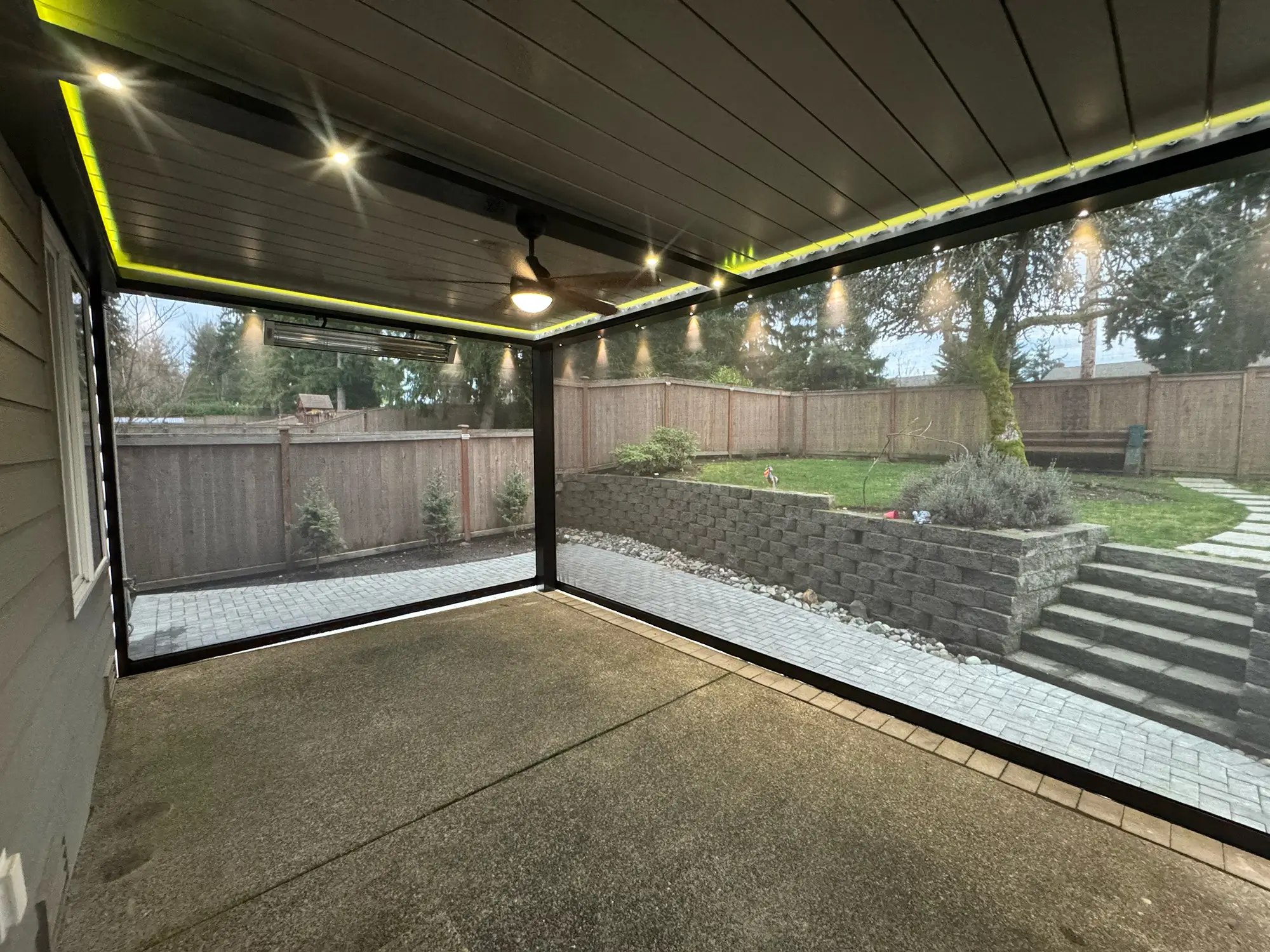
Outdoor solar shades are exterior fabric screens on a motor. One button drops the screen down a set of side tracks, and it stays taut in wind instead of flapping. The fabric filters most of the sun’s UV before it reaches your furniture, cuts glare, and lowers the heat coming into the room behind it. When you don’t want it, it rolls up into an aluminum housing and disappears. You keep your view the whole time. From inside, a solar shade reads like a light tint on the world, not a wall.
Retractable awnings are the classic overhead cover. A fabric roof unrolls out from the wall of your house and gives you shade from above. Great for blocking high midday sun over an open deck that has no roof. They pull back in when you want full sky.
Acrylic patio covers are the permanent solution. A fixed acrylic roof that stays up year round, sheds rain, and lets a lot of light through while blocking UV. This is the one that turns a rained-out patio into a space you use in November. It doesn’t move, and that’s the point.
Which one actually stops the heat?
This is where most people are surprised. The reason exterior solar shades work so well is that they stop the sun before it hits the glass. Anything you mount inside is already fighting a losing battle, because the heat is in the room by the time an interior blind sees it.
The U.S. Department of Energy has field-study data on this. Their Building America research found whole-home summer cooling savings of roughly 15 to 25 percent from the optimized use of high-efficiency exterior and interior shades (DOE Building America Solution Center). Exterior products carry the heavy end of that range, because they block sunlight before it ever passes the window.
For a west-facing Seattle deck, that matters more than people expect. A north deck barely needs shading. A west deck in July is a different animal. From about 3pm on, the sun comes in low and flat, straight at the glass, and an outdoor solar shade is the thing that handles it. An awning helps overhead, but low-angle afternoon sun slides right under it. An acrylic cover keeps the rain off but doesn’t do much for a wall of glare hitting you sideways.
Which one keeps your view?
Solar shades win here, and it isn’t close. You pick a fabric openness that blocks the sun while you still see through it. Sitting on the deck, you look out at Lake Washington or your yard through a soft screen, not a solid panel.
Awnings keep your side views open but cut off the sky above you. Acrylic covers keep everything open because you see straight up through the acrylic, though over years the panels can pick up some haze depending on the product.
Which one survives a Seattle winter?
All three are built for the weather, but they handle it differently.
Acrylic covers are the toughest because they’re fixed and engineered to shed rain into a gutter. They stay up through the whole wet season and ask nothing of you.
Outdoor solar shades handle wind because the fabric rides in side tracks that keep it tensioned. In a serious windstorm you retract the screen, which is standard practice for any retractable system, and the roll tucks safely into its housing. I’ve installed these through enough Puget Sound winters to know what holds up here.
Retractable awnings are the one you’re most likely to pull in during rough weather. They’re wonderful in summer and you simply use them less in January.
What about cost?
I’ll be straight with you: there’s no honest single number, because price rides on the size of the opening, the fabric or material, and how the motor gets wired. A single porch screen is a small job. A 20-foot patio span with blackout fabric is not. As a rough ordering, a retractable awning and a set of solar shades tend to land closer together, and a full acrylic patio cover usually runs higher because it’s a permanent structure with framing and a gutter system.
The way I’d think about it: buy for the problem you actually have. If your deck is unusable because of afternoon glare and heat, solar shades fix that for less than a full roof. If your deck is unusable because it rains eight months a year, a cover is the real answer and shades won’t get you there. Plenty of our Seattle clients end up pairing an acrylic patio cover with solar shades, so the roof handles the rain and the screens handle the sun and bugs.
So which should you get?
Here’s the short version I give people before we’ve even walked the deck.
If your problem is heat, glare, and bugs on a covered deck or patio, and you want your view, go with outdoor solar shades. If your problem is that an open deck bakes in midday sun and you want overhead cover you can pull back, look at a motorized retractable awning. If your problem is that rain kills the space for most of the year, you want an acrylic cover, and you can add screens to it later. And if the space is a new build, tell your deck builder up front, because designing for screens during the build is far cheaper than retrofitting them after.
One thing I won’t do is talk you into the expensive option when the cheaper one solves your problem. We deliver every project as quoted, and that starts with quoting you the thing you actually need.
Frequently asked questions
Do you install outdoor solar shades near me?
If you’re in Seattle, the Eastside, or anywhere from Everett down to Bonney Lake, yes. Our crew is based in Bothell and we cover Seattle, Bellevue, Mercer Island, Kirkland, Redmond, Sammamish, Issaquah, Renton, Kenmore, Woodinville, Mill Creek, and the surrounding metro. We measure on site and quote for free.
Are outdoor solar shades better than interior blinds for heat?
For heat, yes. Exterior shades stop the sun before it reaches the glass, so they outperform anything mounted inside. Interior blinds are the right call for light and privacy control. We install both, so we’ll tell you which fits the problem instead of guessing. See our interior window coverings page if you’re leaning that way.
Can I add outdoor solar shades to a deck or pergola I already have?
Usually. The posts or framing need to carry the side tracks and housing, which most well-built structures can. We confirm it during the free on-site measure, and if the structure can’t take it we’ll tell you what it would need.
How much do outdoor solar shades cost in Seattle?
It depends on the width of the opening, the fabric, and the wiring. A single porch screen costs much less than a wide patio span with blackout fabric. Call (206) 600-2225 and we’ll measure on site and give you a real number instead of a range.
Get a free quote
Ready to use your deck again? Call (206) 600-2225, email [email protected], or request a free quote online. We’re a Washington State licensed contractor (#STARCCW791L5), fully bonded and insured, and every screen is built to order and powder coated in house at our Bothell shop. Recent installs are in our gallery.
Star Construction WA
2220 164th Pl SE, Bothell, WA 98012
(206) 600-2225
[email protected]
Serving Seattle and the Eastside. Monday to Saturday, 7am to 7pm.